Birds and Berries

Bullfinch (Pyrrhula pyrrhula)

We have a liberal attitude to kleptomaniac birds. We are quite happy to share the abundance of our raspberry crop with the needy families of warring blackbirds in the hedge, and don’t begrudge the bullfinches a little bit of plum blossom (mind you, they were pushing it last year.). I don’t object to them taking every reachable holly berry from our tree, because I am happy to trek a mile or so to a far more prolific bearer for my Christmas decorations. The walk is good for me. Honestly. With much of northern Perthshire currently in the grip of permafrost, it’s comforting to lurk behind festive windows and watch the resourceful birds make the most of the berries they can find in the garden. In Autumn, blackbirds and robins cheerfully hacked away at the crab apples, but these are long gone. Rowan berries last a bit longer, and if you have a pink or white berried Rowan (Sorbus hupehensis or cashmeriana are the species to look for) the birds may leave some till winter ends. If your tree is prolific, grab your own share for delicious rowan jelly to go with Christmas dinner or game; and a decent country wine can be had from them as well. Added to which, of course, a rowan tree in your garden will provide protection against evil spirits! (Turning off the TV has a similar effect). We have a Guelder Rose (Viburnum opulus) in the garden. It’s not a rose of course, but a small tree or shrub also known as Cramp-bark. You will not be surprised to hear that its bark was used to appease stomach cramps, among other things. The berries, which follow the creamy flowers, are a beautiful translucent red and are borne in such abundance, some are on the tree still, despite being raided by finches, starlings, robins and the Bankfoot United Sparrow Thugs (currently running in a gang with chaffinches and siskins it seems). If the birds can spare any, Cramp-bark berries may be used in tarts and sauces (but are indigestible to us unless cooked and sweetened), and may ward off scurvy should your Christmas diet have been short on Brussels sprouts! Between us, the birds and I have polished off the elderberries long since, but it’s a shrub I would highly recommend for wildlife if you have room. In fact I am not sure how anyone can manage without it – aside from its many household uses (dyeing, firewood, cosmetics, wood stains, charming warts and so on…..), 70 illnesses were recorded in 1666 by Martin Blockwitch in his “Anatomie of the Elder” against which this much maligned “weed” is effective! Of the more “gardeny” shrubs, Pyracanthas, Berberis and most cotoneasters will still have fruit on to feed hungry birds – and, of course, nectar for bees when the flowers come again. Which they will.

© Margaret Lear, Bankfoot. Originally published in Comment, January 2006.
Tyninghame Gardens and Orchards

I have just visited a very important and very well maintained fruit garden in East Lothian and thought a wee report was needed! It opens under the Scottish Gardens Scheme twice a year.

There is evidence that, by the 12th century, Tyninghame was a Monastery served by Lindisfarne, but also that St Baldred was there in the 8th century. As in many areas of Scotland, fruit and medicinal plants would have been grown by the monks, and the tradition continues here today. The Bishop’s of St Andrews used the site also.

Tyninghame Gardens and Orchard. Photo by Appletreeman. www.plantsandapples.co.uk

In 1628, the !st Earl of Haddington acquired the property, which remained in the family until 1987. He and his wife planted many trees and tamed what was an open wild landscape.

The lovely red sandstone of the house was added by William Burn in 1828.

The walled garden dates from 1750, and had heated walls originally. It is some distance from the big house and there are restored glasshouses with figs, peaches and vines.

Tyninghame Gardens and Orchard. Photo by Appletreeman. www.plantsandapples.co.uk

The 12th Earl and Lady Sarah formed much of what we can see today – post war they started to remodel the walled garden from one employing 8 gardeners by changing it to an ornamental one. He died in 1986.

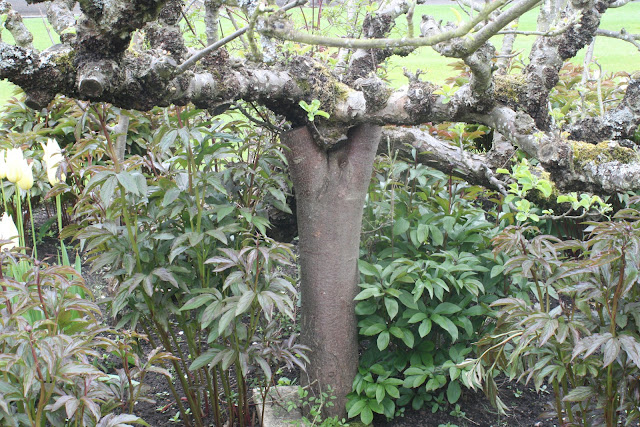
The last 50 years saw low maintenance as the order of the day, with an arboretum planted, and annuals replaced by roses in the secret garden, and many borders grassed over, but luckily some old apples remain in the walled garden. These old ones are ow standards and several are propped to keep them up; a fine younger orchard in the north west corner has some exciting old Victorian varieties. Here can be found dessert fruit of King of the Pippins, a golden pippin / cox cross, Cellini,
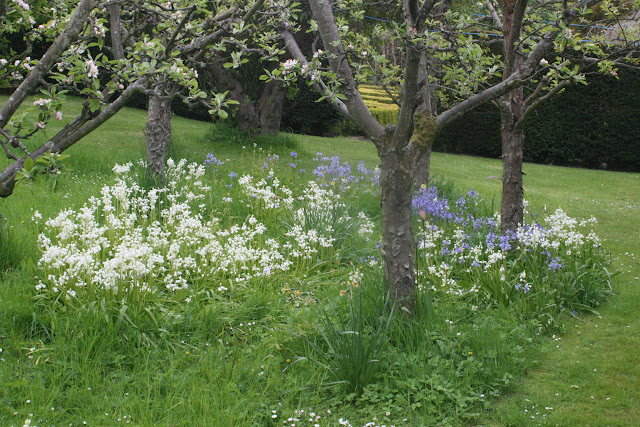
Laxton’s epicure and exquisite, a Cellini / Cox hybrid. Epicure is a wealthy / cox cross – I think someone liked their Cox apples! These are set in long grass with patches of bluebells. Devonshire Quarrenden, an early flat crisp apple, can be found within a boundary of old espaliered trees, nicely set within the gravel.

At the north end of the walled garden is apparently what used to be an apple store.

Tyninghame Gardens and Orchard. Photo by Appletreeman. www.plantsandapples.co.uk

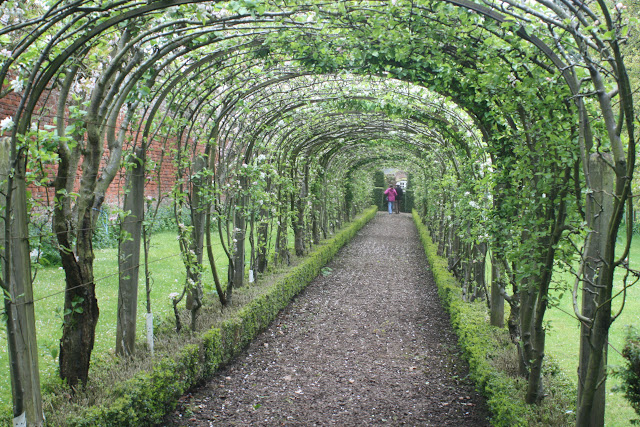
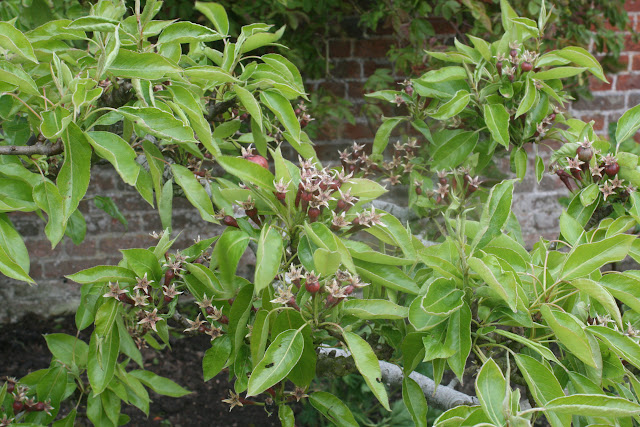
A very productive Louise Bon De Jersey pear lines the west facing wall, with golf ball sized fruits in May, and some Victoria plums form the centre of an ornamental display. Two small medlars on quince rootstocks stand near the gate to the Apple Walk. This is outside the south wall and is of cordons over a substantial post and wire arch. Many varieties here, but indiscernible except for labelled Discovery and Allington Pippin. Many appear to have been grafted in situ, with lots of
woolly aphid and canker. This may be a result of the considerable shading of nearby trees.

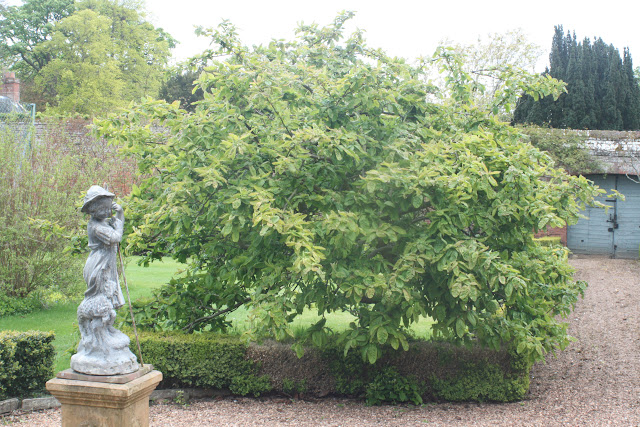
The apple walk in the secret garden, originally under-planted with pheasant eye narcissisi, blue grape hyacinths and geraniums, has almost gone, only a few standards remaining. A fine big Malus floribunda overhangs this area. These old trees may have been the apples trees that supplied the scions for the collection of Scottish varieties sent to the National Fruit Collection in 1949 by a Mr Brotherston, the head gardener.

Tyninghame Gardens and Orchard. Photo by Appletreeman. www.plantsandapples.co.uk

The following varieties were saved for posterity by Mr Brotherston in 1949:

  • Leathercoat Russet
  • Yorkshire Aromatic
  • Small’s Admirable
  • Love Beauty
  • Liddell’s Seedling
  • Lass o’ Gowrie
  • Lady of the Wemyss
  • Green Kilpandy Pippin
  • East Lothian Pippin
Tyninghame Gardens and Orchard. Photo by Appletreeman. www.plantsandapples.co.uk

Many thanks to Chas and Albert, current and retired head gardeners who have done a fantastic job of maintaining this lovely garden.

Alexander and Brown, Perth

Alexander and Brown were very famous seedsmen in the High Street, Perth, supplying plants, bulbs and seeds to uk and continental customers. They were in business from 1897 to 1981, when they were taken over by W. Smith & co. of Aberdeen. Alfred Bown was born at Montrose, and was originally apprenticed to Dickson and Turnbull ( of Perth Nurseries) in 1897 before joining Alexander. They produced a catalogue every couple of years, and their vegetable seed list is most interesting, but Appletreeman’s main interest is where they got their ‘English grown’ fruit trees from and who they were supplying locally.

They started putting English grown fruit in their catalogue from around 1901. The varieties they sold were:

Apples

  • Arbroath Oslin
  • Beauty of Moray
  • Bismark
  • Blenheim Orange
  • Bramley’s seedling
  • Codlin Keswick
  • Court of Wick
  • Cox’s Orange Pippin
  • Devonshire Quarrenden
  • Duchess of Oldenburgh
  • Dumelow’s Seedling
  • Early Harvest
  • Ecklinville Seedling
  • Emperor Alexander
  • Golden Spire
  • Lady Sudeley
  • Hawthornden ( old ).
  • Kerry Pippin
  • King of the Pippins
  • Lane’s Prince Albert
  • Lord Derby
  • Lord Grosvenor
  • Lord Suffield
  • Mank’s Codlin
  • Northern Dumpling
  • Peasgood’s Nonsuch
  • Ribston Pippin
  • Reinette du Canada
  • Stirling Castle
  • Tower of Glamis
  • Warner’s King
  • Worcester Pearmain

”….other varieties can be had on application……”

Pears

  • Bergamont Gansel’s
  • Beurre Bachelier
  • d’amanalis
  • D’Aramberg
  • Diel
  • Rance
  • Bon Chrétien ( Williams )
  • Bishop’s Thumb
  • Clapps Favourite
  • Colmar
  • Crawford Early
  • Glou Morceau
  • Doyenne d’Ete
  • Hessel
  • Jargonnelle
  • Louise Bonne of Jersey
  • Marie Louise
  • Moorfowl Egg
  • Passe Colmar
  • Swan’s Egg
  • Thompson’s
  • Vicar of Winkfield

Plums

  • Belle de Septembre
  • Coe’s Golden Drop
  • Czar
  • Damson
  • Early Prolific, River’s
  • Gage, Blue
  • Green
  • Oulin’s Gold
  • Purple
  • Jefferson
  • Kirke’s
  • Magnum Bonum, Red
  • White ( White Mogul )
  • Orleans
  • Early
  • Pond’s Seedling
  • Prince Englebert
  • Reine Claude de Bavay
  • Sharp’s Emperor
  • Victoria
  • Washington

Quite an impressive list! It is very likely that these varieties survive in the older gardens of Perthshire today. Let me know if you think you have one!

Cider for Christmas?

I am not sure if any of the cider will be ready for Christmas. Some of it should be. We racked it off this weekend, but one or two gallons are still fermenting furiously. It is astonishing that although every gallon was made on the same day, in the same conditions, and all with assorted apples, no two jars are alike. They have all been on the same windowsill, but some started late, some finished early, the colours all vary slightly and the taste – as far as we have tested – also varies from very sweet to getting dry. NONE – so far – taste sour or vinegary I’m glad to say!

Morning sun gets the cider bubbling

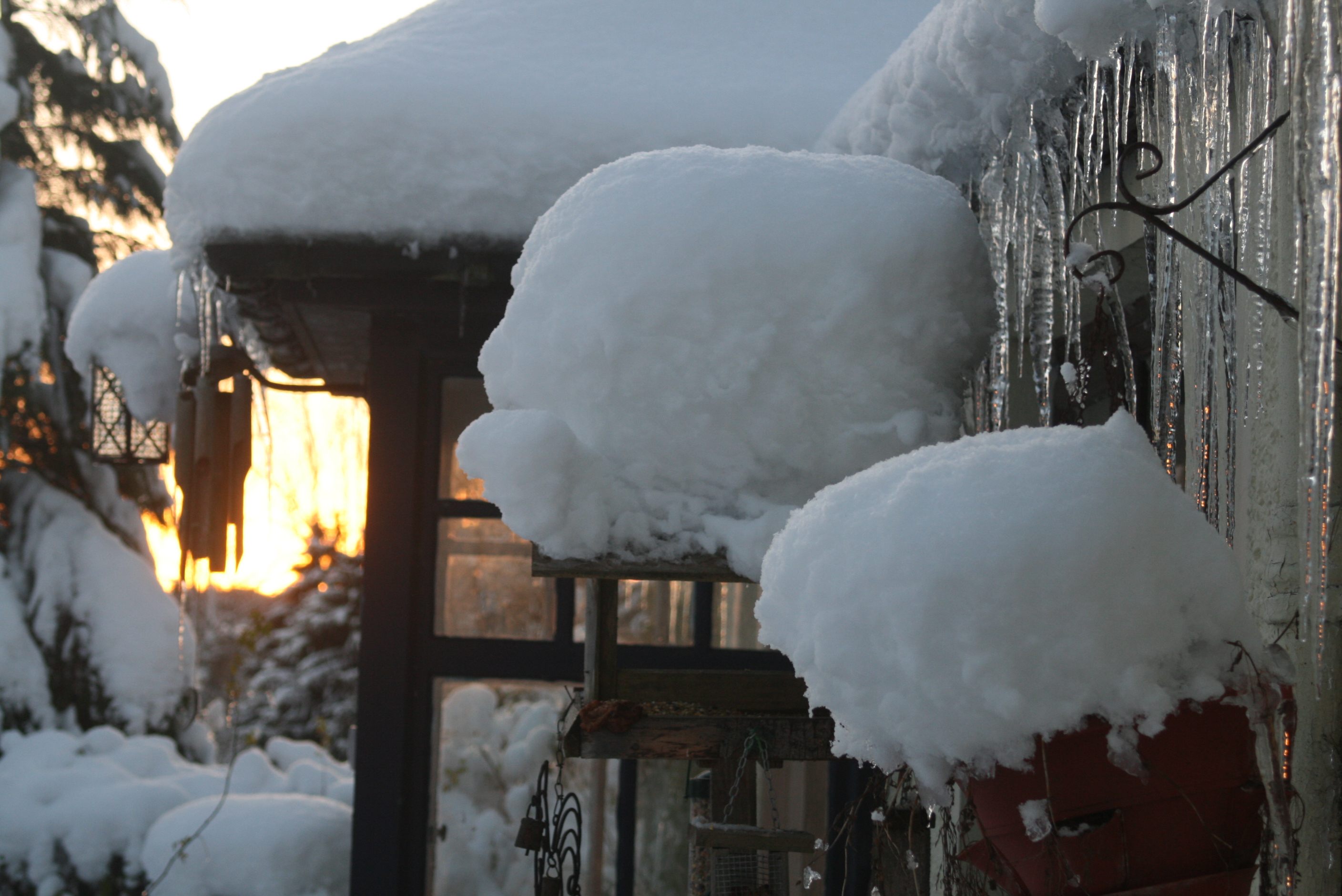
A slight thaw towards the end of last week – many wild birds are very glad of the food we are all putting out, and now finding more that had been covered by the snow. The blackbirds are especially fond of the apples that are not going to last in storage. Waxwings are about in the oak tree at the top of our road, and spotted woodpeckers have been seen (but not by me). Tremendous icicles formed hanging gardens and broke gutters; now it has turned icy cold again and the partially melted snow has refrozen to a skating rink. I never took to skating.

Hanging Gardens

Snow on snow….

As most of the country will have realised by now, last Thursday’s centimetre of snow was just the beginning! We now have 30cm of it outside, and as our little uphill road is unadopted, there’s no prospect of it getting cleared. We spent yesterday afternoon digging tracks to get the car shifted to the bottom, as we are low on hen food and felt panicked enough by the forecast of heavy falls today to get out and stock up. Back home, now, burning logs and drinking last year’s sloe gin… the only foraging to do will be from those toilet rolls sprouting oyster mushrooms on the window sill! Being snowed in does allow you to catch up on jobs that tend to get left – I have baked and frozen cakes, and shelled and roasted all the hazelnuts. Eaten some, too…..

The snowy landscape is beautiful, and people in Bankfoot are out on foot and meeting neighbours they never spoke to before, while the kids swarm all over the little hill of the Monny on sledges and are not missing school. But I have some anxiety – it’s only the first of December. We can only expect winter to deepen. Is this the landscape for the next three or four months?

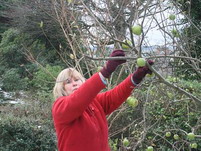
Picking apples in the snow

On Thursday we woke to snow, not more than a centimetre, but snow. Frosts and wind over the preceding week had taken the last leaves off fruit trees, leaving roadside late apples looking like pre-Christmassy hung with the green or golden baubles of the later-ripening fruit. The Mysterious Large Apple in our front garden was no exception. For 9 years it has produced a small number of dense green fruit streaked with grey because it is in the shade; it is meant to be Ribston Pipin, but apart from the lateness of the crop (left to their own devices the apples will cling on till January and never get any riper) it bears no resemblance. Hence Mystery. Yet it grows like topsy, the blossom is magnificent and loved by bees.

This year it grew hundreds of apples, and they got to a decent size and some went a slightly golder shade of green – one or two even got rosy flushes. Whether this was due to a warm, sunny summer or the deep freeze of last winter I am not sure, but with snow falling, we decided to pick the lot and store them (they do store very well, possibly for eternity). They all had to be washed and polished free of the grey streaks, and made baskets of pretty green apples which taste just OK but the skins are tough; peeled and cooked, they do the job. Update on taste progression at Christmas.

And now, Sunday, we have 15cm snow and falling fast, thunder and lightning bizarrely, and strange lights in the sky last night, amid a glut of crazy frozen stars.

Baby Oysters!

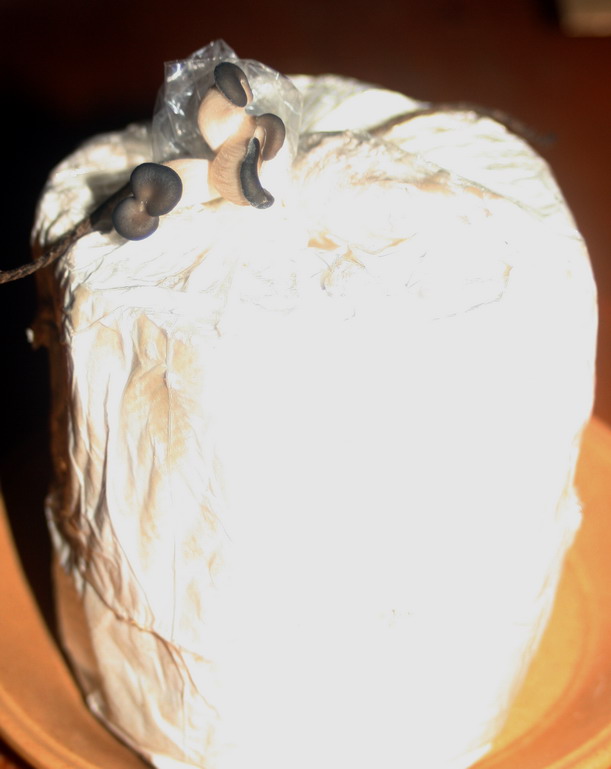
No, not shellfish, oyster mushrooms! The most amazing and intriguing new additions to my household are the fruiting bodies of oyster mushrooms that are growing out of two impregnated toilet rolls on the window sill….. I got the spawn (mycelium mixed with grain) from Ann Miller’s Speciality Mushrooms of Inverurie, together with instructions. You soak a whole toilet roll and put it in a plastic bag; break up the spawn and put it into the middle of the roll. Seal up the bag. Then I had them in the airing cupboard for 4 weeks, the fridge for 5 days, and then the window sill (relatively cool) for the past week. At this point you make wee holes in the bag. And Lo! exquisite little oyster mushrooms gather up behind the holes and burst through. I should say the entire toilet roll at this stage is a mass of fungal mycelium – it is eerie and fantastical to watch it develop and form embryo mushrooms almost before your eyes.

Blooming well beats anything on television. And edible too!

You can get the spawn if you email ann@annforfungi.co.uk Loo rolls – the recycled ones from Lidl seem to work! The fungi break down the cellulose in the paper. As edible mushrooms seem thin on the ground just now in the wild, I am well impressed!

Cider Day

In between the days of heavy rain and wind and almost-sleet, Sunday was a fine, sunny day; cold, but nice to be out. So we made cider. We hired the electric crusher and big press from the Carse of Gowrie, Stuart brought his hefty home-made press and I had our little mini-press too, which did Catherine’s juicing apples nicely. Apples arrived in wheelbarrows and crates and plastic bags. We congregated under James’s Folly – which is a handy covered ediface erected principally for barbecues and resembling the Alamo – and got to work. Between 11 of us we processed roughly 30 gallons of cider-to-be and a gallon of juice in two and a half hours. Guess where the party’s going to be in a few months!

James did a couple of single variety gallons using his Golden Spire apples. Geoff brought some very pretty little red eaters – possibly Discovery; whereas most of the juice at this stage is an unappetising brown sludge (but delicious), Geoff’s was a lovely pinkish-red sludge – reckon that will be a handsome cider rose. One jar came out alarmingly clear – eerie! Our apples were the usual collection of weird and often unidentified subjects collected by Andrew over the past couple of months that have been gently festering around the house.

After we’d cleaned all the kit, we discovered another bucket of as yet unprocessed apples. And then a hard frost took all the leaves off the local apple trees, and beside roads and in gardens across Perthshire, there are strange Christmas trees of apple, with the late fruits hanging on like green or golden baubles….. More to do yet!

Long slow spring…..

Today heard the first cuckoo, in the woods fringing Glen Garr. Was with HNC Countryside Management atudents and the last time I dragged them for a walk we saw the first swallows down on the Tay Estuary – so I think the class are my lucky spring charms. They do seem to expect

Long time no blog – winter went on and on, nothing much to report and I realise I am about to repeat everything I wrote about last year if I don’t watch out. Will try to be selective….. the apple mountain finally petered out late February, with the blackbirds getting the last of them. Andrew borrowed the Carse of Gowrie cider press and the crucial crusher and made 11 gallons of cider and perry – we are still drinking it and mist of it is truly excellent. We have added to the fruit trees in our garden about 11 apples, 3 or 4 pears including the famous Perthshire Jargonelle, and a couple of plums and a damson. They are all leafing out nicely.

Have made wild garlic pesto and earwigging to Radio 4 and the like tells me the whole world is making stuff with wild garlic these days! It’s much in demand from customers too. Bistort, nettles, ground elder, comfrey and ladies mantle have all been et – both in and out of Dock Puddings, and Solomon’s Seal has produced its delectable shoots. Magnificent!

Have not found any St. George’s mushrooms yet. We found a red Peziza type fungus the other day – Scarlet Elf Cup – which we’d not seen before. Inedible but very pretty. Nearby we found a lizard out basking, which reminds me – on a student trip to the Rhinns of Galloway a morning walk at Portpatrick yielded a BEAUTIFUL adder by the path, fulmars and nesting ravens, and a stoat.

 Well, a new season dawns, and my “pet” early potatoes called Bonnie Dundee (but labelled Claverhouse out of badness) are coming up….

snowed under…

There is a lot of snow. Several inches over the week or two before Christmas, and a couple of massive falls in the past four days. 30cm last night. Temperatures: -11.2 the lowest so far recorded in the garden, -8.5 today. It went up to -4.2 and felt quite warm. Small birds are suffering. I have been feeding them; especially on apples. There are still two crates of random apples in the back porch and birds and possibly small mammals have helped themselves. The apples have frozen and thawed a few times, but seem still usable. Blackbirds love them, and I have had two fieldfares coming to the bird table every day, beautiful, fluffed up creatures looking for fruit and seeds. Sparkly speckly starlings come, too and a wood pigeon joins the collared doves who are resident. James over the road has had a spotted woodpecker.

There is no foraging to be done but we reap the rewards of a year spent squirreling away wild foods. At Christmas we broached the cider – it is sparkling, and not at all bad, but think will be even better in a couple more weeks. Got freshly pressed apple juice out of the freezer, too, and had plenty of rowan jelly for the turkey (yes, succumbed to a turkey even though we have home raised cockerels in the freezer), chutney for the sausage rolls, blaeberries and raspberries for the trifle and more home made wine and sloe gin that we can decently drink. Roasted hazelnuts from the copse, and a late jarring of rose hip syrup to keep up the vitamin C levels. Log foraging has sort of paid off – plenty of fuel for the stove but would be a darned sight more useful had Someone agreed with my desire to build a new log store out the back – wet logs in plastic fertiliser bags that fill with snow are limited in value.

My nursery is covered in snow. I cannot do anything about it and probably will lose a lot of plants in the extreme cold. I am going through the seed catalogues half-heartedly but not counting on an early start to production!