
Our 2017 trees are growing away nicely with all this rain now, but so are the weeds! So sorry, no definitive list for winter bare root trees yet, but hopefully over the next few weeks we will find time to do an initial stocktake! Please email in a few weeks if you want us to reply to you with this list.
Author: Lynsey Payne
Aronias
You may have come across Aronia juice, a new superfood full of anti-oxidants, but are you aware we can grow them here in Scotland? Aronias have the common name ,Chokeberries, a name which doesn’t do it any favours!
It is a small deciduous shrub, several of which I have been growing in my field for the black fruits and lovely white flowers in spring.The fruits are about 7mm wide, similar to blueberries or even blackcurrants, and with no big seed inside like a damson.
There are several species and varieties. The Black Chokeberry is A. melanocarpa, A. arbutifolia is the Red Chokeberry, the hybrid of the two is the Purple Chokeberry, prunifolia. I haven’t tasted the red form, I wonder if there’s one in a botanic garden somewhere? They are reportedly sweeter.
They are all native to North Eastern United States. though some naturalization has occurred in Europe. They have a long history of use by native American Indians as a food, medicine and a dye plant.
They are very hardy, and equally heat tolerant in the US zones from 3 to 8.
The varieties “Brilliant’ , ‘Nero’, ‘Viking’ and ‘Autumn Magic’ can all be found in Garden Centres and have been selected for their fabulous autumn colouring. They are however all strikingly attractive wee shrubs for the shrubbery or woodland edge. Viking can grow to 6 feet, Nero is shorter, at 4 feet, but has larger fruit.
The leaves are reportedly used to make a tea, but it is the slightly earthy tasting, mildly sweet black berries in summer which are of most interest. My two year old little black chokeberry bushes produced a really nice crop last summer. Eaten straight off the bush I rather liked them ….so many apples and pears these days are too sweet for my taste.
The native black chokeberry is only 1.5m high and spreads by root suckers to about 3m wide, so it forms a nice compact little bush. The red form is a touch taller.
Aronias have been grown in Europe for a long time now, but only recently been considered a commercially viable crop. In Poland, many thousands of hectares have been planted for juicing. They use a selected form, Galicjanka, a tetraploid Nero form specially chosen for planting in rows and for harvesting by machine. It was selected at the Institute of Pomology in Albigowa, South East Poland for its productivity and evenness of ripening.Despite being of the rosaceae family, they are all reported to be relatively pest free and tolerant of a wide range of soil conditions, though preferably not too wet, and definitely not too dry. Not a problem here! Watch out for powdery mildew though.
Varieties are all propagated by root suckers. We have a few to sell here at the nursery ; more varieties will be sourced and trialed in future years!
A.Lear. 2016.
Heritage Pears
I have for several years now been propagating some of Scotland’s old pear varieties. Between Perth and Dundee there are still a few very old orchards with big productive old trees, perhaps 200 years old, many hollowed out, and each year more of them blow over. The race to save these varieties has never been more important. One way of doing this is to propagate by grafting. This involves taking a healthy twig off the tree and grafting it onto a specially grown pear rootstock.
I have been working with The Heritage Pear Project nationwide, a group of volunteers attempting to improve their pear dentification skills, and going out into orchards locating and propagating those unknown or rare varieties. Contrary to popular belief, these pear trees produce tonnes of fruit, unlike many of the dwarf modern varieties planted in our back gardens today.
In the Carse of Gowrie, I have been particularly interested to propagate those trees identified as unknown in a DNA survey carried out by the University of Reading for Perth and Kinross Countryside Trust. This survey pulled out some unusual varieties such as Windsor, Chaumontel, and Laxton’s Superb ( yes I thought this was an Apple only!). More predictable was the regular occurence of Hessle, Craig’s Favourite ( a Perth variety ), and Green Pear of Yair from the Borders. The well known Conference was found at Ballendean, together with Buerre D’Amanlis, plus Catillac, a large triploid cooking pear and Swan’s Egg at Megginch Catsle.
All very interesting, but equally so, around a quarter of those tested proved to have no matching trees at the National Collection in Kent. Which means they they could be seedlings bred by local fruit growers such as Patrick Mathew over hundred years ago, or perhaps simply a named variety from Belgium or France not represented in the Kent collection.
So, over the last few years I have been propagating a few of these un-named trees before they collapse and are lost for ever. Occassionally we have some spare to sell, they may not be named, but simply have a number! If you have a big garden and space for a big pear tree do please get in touch and help us save these varieties!
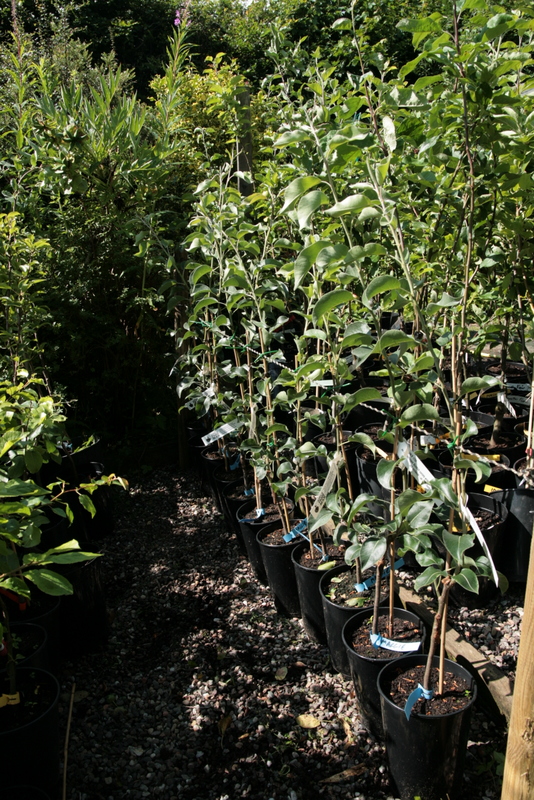
Heritage Pears
Anyone for Tea?
We have a small number of hardy Camelia sinensis for sale in 5 litre pots. They are growing away nicely and already yielding afew leaves for our daily brew! Tea is now being produced in Scotland, proving that they are perfectly hardy! They are calcifuge, so generally prefering a slightly acid soil, some shade or northern facing slopes may suffice, and tolerate a fair amount of rainfall, though a variety of loamy soils and areas of Scotland are proving to be acceptable. See the following information sheet for more details:Appletreeman’s Guide to Growing Tea in Scotland
Saskatoons
We have a selection of specially imported Canadian Saskatoons for sale in 3 or 5 litre pots.
These trees produce a fabulously sweet blue berry in July, and are similar to Blueberries. They differ in that they do not need acid soil and prefer good sunlight and any good loamy soil.
The varieties we have for sale are Smoky, Thiessen, Northline and JB 30. These are all commercially selected for their superior sized and quality fruits from tlocal wild trees in central Canada.
They are very hardy, and reach between 2.5 to 3.5 metres. Pruning involves cutting out a few of the tallest trees in a few years time. They are likely to be productive for 40 years or more. Our specialist guide gives more information.
Monarch
Some big tough old Monarch trees can be found in Scotland. It is a good late cooker for many areas of Scotland, in Stirlingshire i have sen the fruits still on the trees well into January.
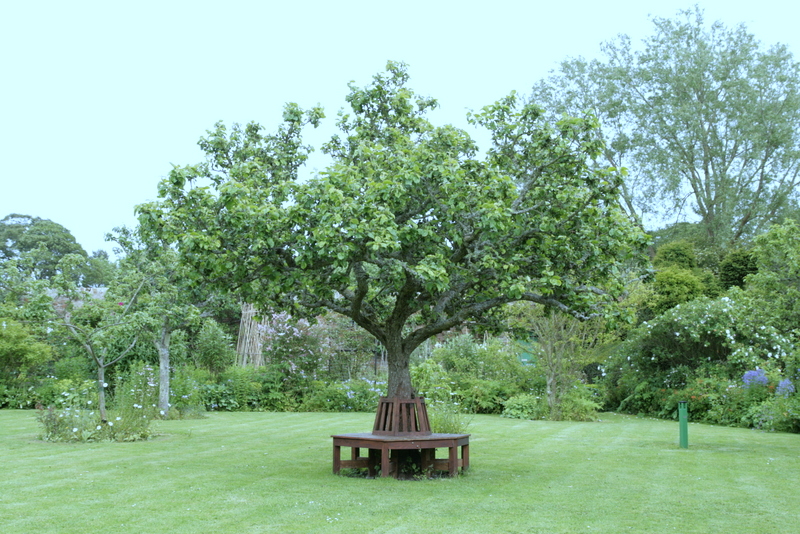
Monarch Appletree
Worcester Pearmain
A juicy crispy white fleshed early October eating apple, once grown extensively commercially but now much superceded by more modern varieties. I have a prolific tree in my garden, though i had to learn to prune it as a tip bearer to get it to do so! A deliciou
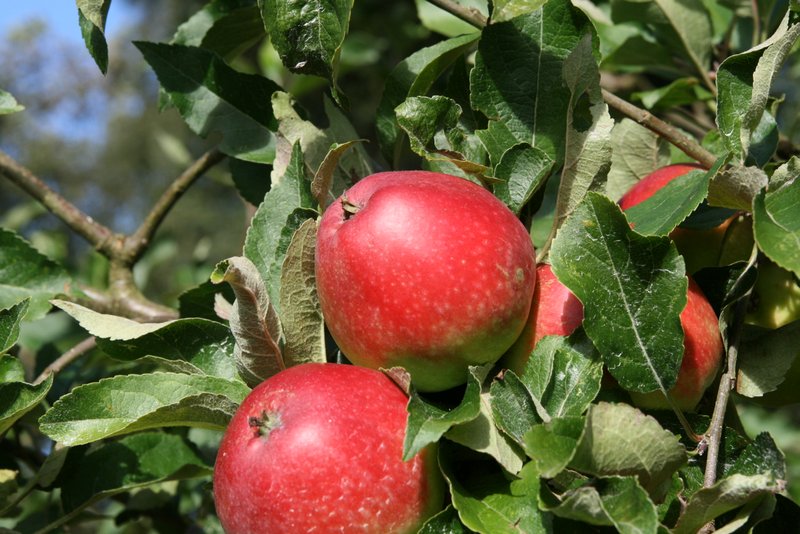
Worcester Pearmain
Cider Trees
Further to my previous blog, I can report that several grafted Cider varieties are now looking good. They include the following:
Porter’s Perfection, on M26 and MM106,
Stoke’s Red and Dunkerton’s Late, on MM106.
Le Bret on M26.
Send us an email if you want to reserve any of these for planting this Autumn.
Last years cider apples came by the trailor load!
Stobo Castle
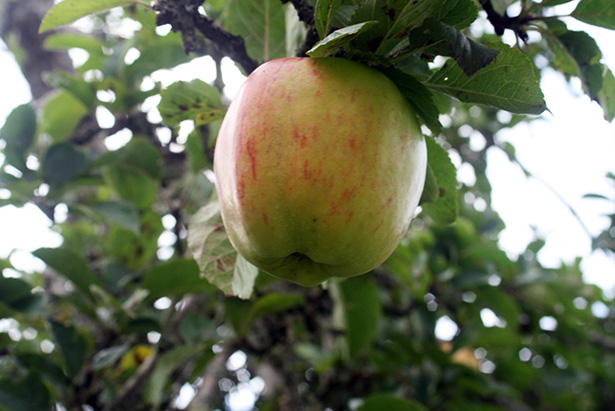
Stobo Castle
Scottish Variety
Like a flat Stirling Castle: deep golden with a scarlet flush, Stobo Castle cooks to a sharp creamy froth. An early apple, named by David Storrie. Always strong trees in the nursery.
White Melrose
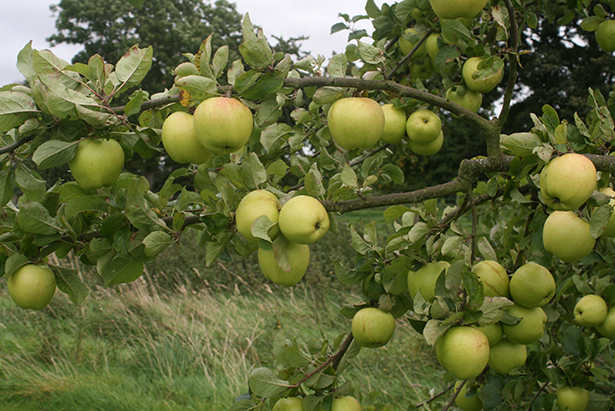
White Melrose
Scottish Variety
There’s a tree at Melrose Abbey – an old wizened stick – presumably the mother plant. Ribbed, yellow dual purpose apple. I happily munched one at Elcho Castle last year and was surprised to see the label. Used to be commercially grown in the Borders.
 plantsandapples.com