Read our 2016 Catalogue

Hurrah! Our 2016 Catalogue is Out!

Inside, you’ll find lovely lists of purposeful plants to choose from this year, from ‘plants on the wild side’ to ‘how to be soft on fruit’! Also, look out for Wild Flower Plugs (new!), Fruit Trees, Workshops and Consultancy.

PLUS, as it’s our 15th anniversary, we’ve got some special offers for 2016. Skip to the back page to find out more.

 Read the catalogue below or click here to download a copy (700kb)


Happy browsing!

Spotting the first Hazel flowers

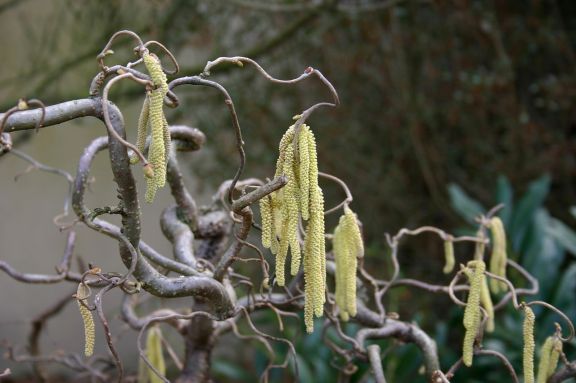
I realised the other day that I now need my reading glasses if I’m going to be the first in the family to spot the 2016 female hazel flowers. I have to be a certain distance away from the tree to be able to focus on the bulging, pink-flushed flower buds. But, at that distance, I don’t stand a prayer of spotting the flowers, on account on them being so minute – not much more than pin-head sized. In their favour, they’re bright red, and very pretty, like tiny wee starfish.

corylus contorta

Hazels are monoecious (male and female flowers are separate, but borne on the same tree), and the male catkins have been there since before Christmas. Up to now, they have been tightly furled, but are showing signs of opening. Wind will blow clouds of ripe pollen onto the female flowers, and nuts will follow! Wild hazels are self-incompatible, so you need more than one bush to get a harvest and generally the more the merrier. Our local hazel copse – which we don’t own but just act as though we do – has a hundred or so, and many seedlings coming along. I planted a single wild hazel in my garden 12 years ago, and have never seen a nut on it – not surprisingly!

Named hazelnut or filbert cultivars like ‘Cosford’, ‘Hall’s Giant’ and ‘Nottingham’ are often claimed to be self-fertile, and we’ve now added a couple of these to the vicinity of my first, barren attempt at nut growing, so things should change! But the one variety in my garden that’s started producing nuts is the one I least expected to – my Contorted Hazel (Corylus avellana ‘Contorta’). I know “Harry Lauder’s Walking Stick”, as it’s also known, is a bit of a Marmite shrub – but I love it for the sheer weirdness of the twisty branches seen from the kitchen window in winter – and its precocity in producing real, home-grown hazelnuts!

Meantime, must remember the specs on the next walk round the hazel copse….

Walnuts In Scotland

Walnuts

Walnuts were highly valued as a timber tree centuries ago, but 2015 was a good year in Scotland for the nuts too…our neighbours ‘Buccaneer’’ produced a good crop of nuts. So I thought I would do a bit of research on varieties and their relative merits. Maybe we should be growing more in Scotland? They can even be grown as a hedgerow system, not unlike many apple orchards around the world today.

I know of a few very big old walnut trees in Scotland, so I imagine a need for a less vigorous cultivar would be very useful for most of us. My neighbour’s tree is 8 years old and already romping away at about 12m and growing a meter a year!

It is presumably self-fertile as there are no others in the area.

We have a few seed sown trees for sale here at the nursery.
 

Walnut Tree

Walnut Tree

The Common walnut is Juglans regia, the black walnut, and is native to Persia, Juglans nigra. Is native to North America. Both can produce edible nuts.

The fruits are actually a drupe not a nut! You can expect cropping from 3 to 5 years from many varieties.

Romania is the biggest producer with production of up to 23 tonnes per hectare, but there’s a wide distribution of production from China, through India, Iran, France, and increasing production in Morocco.

( see: http://www.highatlasfoundation.org/).

Over 30 varieties are listed in Wikipaedia (https://en.wikipedia.org/wiki/Walnut ), but here are the most commonly available varieties in UK and abroad:

Buccaneer – A self-fertile Dutch round nut variety. Good for pickling. Upright tree.

Fernor – A new precocious flowering French variety.

Franquette – an old variety, a tip bearer! Doesn’t need much pruning.

Rond De Montignac – another old French variety with smaller nuts and late to leaf out.

Broadview – supposedly less vigorous than others.. self-fertile, precocious, and reputedly frost hardy. From Canada.

Saturn – A Czech variety 1971

Rita – From Carpathians, a smaller tree with thin -shelled nuts.

Lara- a commercial French variety, compact, needs a pollinator

There are many varieties more in France and around the world!

The RHS suggest taking out the central leader if you want to keep the trees in check. Also avoid pot bound plants as the tap -root will be damaged and they hate transplanting so don’t move them once they are planted.

Do not plant them near to apples as the roots exhibit allelopathy – preventing other trees growing. Most need at least 7m spacing between trees.

Grey squirrels, leaf gall, anthracnose and Codlin moth can all be problems with Walnut trees.

So is there anyone in Scotland interested in growing and trialling varieties for a commercial crop of walnuts, i.e. a hedge of them?



Aronias

You may have come across Aronia juice, a new superfood full of anti-oxidants, but are you aware we can grow them here in Scotland? Aronias have the common name ,Chokeberries, a name which doesn’t do it any favours!

It is a small deciduous shrub, several of which I have been growing in my field for the black fruits and lovely white flowers in spring.The fruits are  about 7mm wide, similar to blueberries or even blackcurrants, and with no big seed inside like a damson.

There are several species and varieties. The Black Chokeberry is A. melanocarpa, A. arbutifolia is the Red Chokeberry, the hybrid of the two is the Purple Chokeberry, prunifolia. I haven’t tasted the red form, I wonder if there’s one in a botanic garden somewhere?  They are reportedly sweeter.

They are all native to North Eastern United States. though some naturalization has occurred in Europe. They have a long history of use by native American Indians as a food, medicine and a dye plant.

They are very hardy, and equally heat tolerant in the US zones from 3 to 8.

The varieties “Brilliant’ , ‘Nero’, ‘Viking’ and ‘Autumn Magic’ can all be found in Garden Centres and have been selected for their fabulous autumn colouring. They are however all strikingly attractive wee shrubs for the shrubbery or woodland edge. Viking can grow to 6 feet, Nero is shorter, at 4 feet, but has larger fruit.

The leaves are reportedly used to make a tea, but it is the slightly earthy tasting, mildly sweet black berries in summer which are of most interest. My two year old little black chokeberry bushes produced a really nice crop last summer. Eaten straight off the bush I rather liked them ….so many apples and pears these days are too sweet for my taste.

The native black chokeberry is only 1.5m high and spreads by root suckers to about 3m wide, so it forms a nice compact little bush. The red form is a touch taller.

Aronias have been grown in Europe for a long time now, but only recently been considered a commercially viable crop. In Poland, many thousands of hectares have been planted for juicing. They use a selected form, Galicjanka, a tetraploid Nero form specially chosen for planting in rows and for harvesting by machine. It was selected at the Institute of Pomology in Albigowa, South East Poland for its productivity and evenness of ripening.Despite being of the rosaceae family, they are all reported to be relatively pest free and tolerant of a wide range of soil conditions, though preferably not too wet, and definitely not too dry. Not a problem here! Watch out for powdery mildew though.

Varieties are all propagated by root suckers. We have a few to sell here at the nursery ; more varieties will be sourced and trialed in future years!

A.Lear. 2016.


Cider Trees

Further to my previous blog, I can report that several grafted Cider varieties are now looking good. They include the following:

Porter’s Perfection, on M26 and MM106,

Stoke’s Red and Dunkerton’s Late,  on MM106.

Le Bret on M26.

Send us an email if you want to reserve any of these for planting this Autumn.

Last years cider apples came by the trailor load!

Of Coltsfoot and Liquorice

Yesterday I found the first scaly-stemmed flower of Coltsfoot pushing itself up through the disturbed ground of a plantation in Bankfoot. The plant, also called “Son-afore-the-Father” due to the fact that the flowers appear many weeks before the hoof-shaped, hairy leaves, is a spring herald. It’s particularly welcomed here because by mid-February I have always been caught by one of those coughs that cling to the tail of a winter cold and threaten to sit on your chest for months. This year is no exception.

Coltsfoot leaves and the sunny, dandelion-like flowers are equally useful for treating coughs, though personally I can’t bear to pick the brave flowers and collect and dry leaves all summer instead to see me through. They can be made into a tea, or a decoction. Of old, they have been used in herbal tobacco, too, but it beats me how smoking anything can cure a cough, so I’ll stick to tea. It doesn’t have much flavour, so I add evergreen thyme (also good for coughs!) in winter, and in summer a few leaves of mint, lemon balm or meadowsweet. Fresh coltsfoot leaves can also be used as a vegetable and even yield a yellow-green dye.

This winter, thanks to an excellent evening class in herbal medicine I have discovered another cough-soothing delight – liquorice.  I have never liked liquorice allsorts, and for all I respect the monks of Pontefract, their “cakes” and the long tradition of growing and processing liquorice in that district, NOTHING would have persuaded me to chew liquorice root if I’d known what it was. But the unprepossessing and rock-hard root is something else entirely. The flavour is sweet and delicate; I’ve been boiling chopped root for ten minutes, then adding coltsfoot leaves. On Bad Throat Days, in goes a spoonful of honey from my bees too. Liquorice has been used medicinally for over three thousand years, for constipation and stomach ulcers as well as bronchial complaints. It’s a substance called glycyrrhizin in the roots, sweeter by far than sugar, which accounts for its use in confectionery. I don’t know which bit makes foam, but it’s also used in fire extinguishers!

Coltsfoot is best gathered in the wild unless you have a large garden – it spreads most obligingly. Liquorice, a native of south-eastern Europe, is slow to germinate, the seeds are expensive, and it will take a while to produce worthwhile roots. But it has pretty foliage and pea-like flowers to enjoy while you are waiting, so is well worth growing.

Today, five inches of snow covered 2005’s first coltsfoot, and I’m still coughing, so spring had better get a move on. The hedgerow pharmacy is in demand!

© Margaret Lear, Bankfoot. Originally published in Comment, March 2005

Snow on snow….

As most of the country will have realised by now, last Thursday’s centimetre of snow was just the beginning! We now have 30cm of it outside, and as our little uphill road is unadopted, there’s no prospect of it getting cleared. We spent yesterday afternoon digging tracks to get the car shifted to the bottom, as we are low on hen food and felt panicked enough by the forecast of heavy falls today to get out and stock up. Back home, now, burning logs and drinking last year’s sloe gin… the only foraging to do will be from those toilet rolls sprouting oyster mushrooms on the window sill! Being snowed in does allow you to catch up on jobs that tend to get left – I have baked and frozen cakes, and shelled and roasted all the hazelnuts. Eaten some, too…..

The snowy landscape is beautiful, and people in Bankfoot are out on foot and meeting neighbours they never spoke to before, while the kids swarm all over the little hill of the Monny on sledges and are not missing school. But I have some anxiety – it’s only the first of December. We can only expect winter to deepen. Is this the landscape for the next three or four months?

Long slow spring…..

Today heard the first cuckoo, in the woods fringing Glen Garr. Was with HNC Countryside Management atudents and the last time I dragged them for a walk we saw the first swallows down on the Tay Estuary – so I think the class are my lucky spring charms. They do seem to expect

Long time no blog – winter went on and on, nothing much to report and I realise I am about to repeat everything I wrote about last year if I don’t watch out. Will try to be selective….. the apple mountain finally petered out late February, with the blackbirds getting the last of them. Andrew borrowed the Carse of Gowrie cider press and the crucial crusher and made 11 gallons of cider and perry – we are still drinking it and mist of it is truly excellent. We have added to the fruit trees in our garden about 11 apples, 3 or 4 pears including the famous Perthshire Jargonelle, and a couple of plums and a damson. They are all leafing out nicely.

Have made wild garlic pesto and earwigging to Radio 4 and the like tells me the whole world is making stuff with wild garlic these days! It’s much in demand from customers too. Bistort, nettles, ground elder, comfrey and ladies mantle have all been et – both in and out of Dock Puddings, and Solomon’s Seal has produced its delectable shoots. Magnificent!

Have not found any St. George’s mushrooms yet. We found a red Peziza type fungus the other day – Scarlet Elf Cup – which we’d not seen before. Inedible but very pretty. Nearby we found a lizard out basking, which reminds me – on a student trip to the Rhinns of Galloway a morning walk at Portpatrick yielded a BEAUTIFUL adder by the path, fulmars and nesting ravens, and a stoat.

 Well, a new season dawns, and my “pet” early potatoes called Bonnie Dundee (but labelled Claverhouse out of badness) are coming up….

David Douglas

David Douglas was born in 1799 at Scone and went to school at Bridgend., as he got kicked out of his first school. There’s a plaque on the wall next to the Isle of Skye Hotel commemorating the life of this son of Perth. He worked for the Earl of Mansfield as an apprentice, and it appears his abilities were soon recognised as he journeyed at an early age to a garden in Fife, and later to Glasgow Royal Botanic Garden.

He was chosen by the Horticultural Society ( now Royal ) to collect plants and specimens of interest from America. He boarded the Ann Maria bound for New York at Liverpool on 5th June 1823, only to find the tide was too low for them to move so he took the opportunity to botanise on land for the day! What a man! Eventually weighed anchor on the 6th and made the journey across the Atlantic to Long Island which was sighted on 31st of June, where he spent the next 5 months collecting plants and sending specimens back to the Horticultural society in London.

The woodland landscape of Perthshire today is partly as a result of Douglas and other botanists sending home conifers from far flung places of the World. Of particular interest to appletreeman is his interest in vegetables and the orchards of the New World.

One of his first observations was the orchards on Long Island! He went to the Vegetable Market, The Fulton, on the 10th and observed an immense variety of plums, and early damsons. Also an abundant supply of pears, peaches and apples. On the 12th he crossed the Hudson to see more fruit orchards, including a Dutchman with 20 acres of peaches and 24 varieties! This man grew rootstocks from seed and budded them in August just like we do today!

David was impressed with Plum Washington which Dr Hossack procured for him. At Burlington on the 20th, David met W. Coxe, who was busy with a cider harvest! On the 23rd he visited Philladelphia’s market, which he thought better than New York’s.

Mr Hogg looked after many of the plants he procured on his travels. He put some osage apples in spirits. Back near New York on the 2nd Sept he saw some Seckel Pears, and an Isabella Grape 75 feet long. He visited West Point and observed more fruit, and then boarded the Richmond steamboat to Albany. What did he do first..yeah visited the Veg Market!

On the way to Little Falls he observed cider presses and orchards everywhere. Mostly apples and a few varieties of plums. He found a place called Caledonia and full of Scots! On the River Detroit he found a wild pears growing and in the old French settlements he saw 8 to 10 varieties of apples called red, white and black. Also pears, probably brought in from France by the immigrants in the previous century.

He found a large and tasty crab apple near Amherstburg. Is this the place Patrick Sinclair set up? He planted an orchard there apparently to supply his troops.

It was at this point that David’s assistant ran off with his stuff when he was up a tree, and when he got down he couldnt control the horse because he couldnt speak French! You couldn’t make it up. He then worked his way to Niagara and Canada, and found the ‘Pound Pear’ being grown. Also Magnum Bonum Plum (egg plum), Blue Orleans and Washington. Also Black Prince and Hamburgh vines.  Then to Rochester and Albany and observed more vines, White Sweet Water, Grizzly Fontignan and Malmsey. Apples and Pears but Plums faring better.

On his travels in Burlington, he got two bottles of cider, one made from wine-sop, the other Virginian Crab apple. On Nov. 14th he went to another veg market (Amboy?), searching for unusual varieties.  On the 12th december he boarded the Nimrod, bound for Great Britain. He had quail, pigeons and ducks ( who were sea-sick), as well as his plants and specimens!

What a rampage he had in the Eastern States of the US!

References: The Plant Hunters , by Charles Lyte, Orbis, 1983 and Journal of David Douglas originally published in 1914 by William Wesley and Son, London.