Medlars

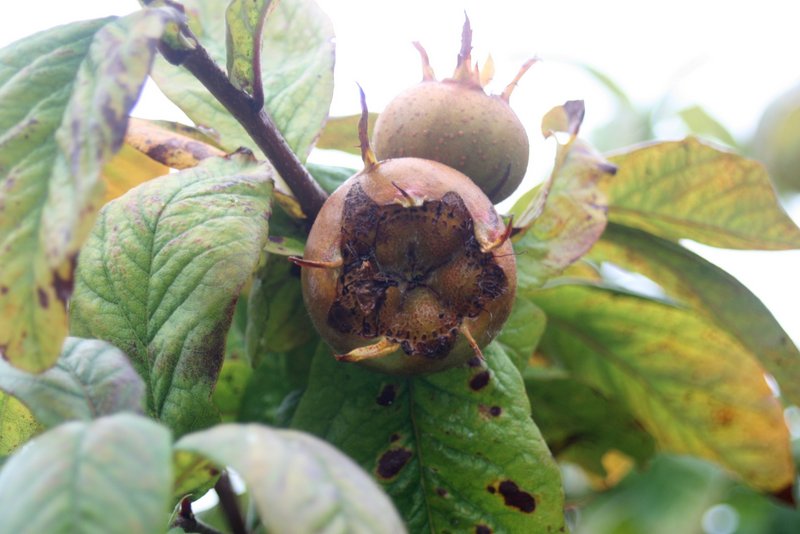
Medlars are rather plain looking trees – admittedly they are rosaceae, but the flowers are just white amongst many other better rosaceae, so why are they of interest? They have been cultivated for thousands of years, and its very likely the Romans brought them here.
Well its the fruit, which is not quite like anything else! They are actually pomes, and are brown, earthy tasting and either hard or soft and almost rotten! They are about 5cm across and brown.We tried some at The Harmony garden at Melrose once, and they were definitely an acquired taste. They are in fact a useful late fruit as they aren’t ready until mid- winter.
So what are they used for. Traditionally they need to be ‘bletted’ i.e. until the frost has softened them. Some suggest this isn’t actually necessary.However, the best use of them is to make into jam or jelly.
They will grow almost anywhere, I have seen them at Kellie Castle in the lawn, and in a hedgerow at Broughty Ferry. Remembering where they are and getting the fruit is important if they’re in a hedgerow.

Medlars

Varieties generally available are the Dutch ( largest fruit), Nottingham ( more upright), and the Royal ( better flavour). Also Breda Giant and Russian clones. We sell Nottingham. All are self-fertile.Named varieties can be grown on Pear, Quince or Hawthorn. They come from the Caucasus, so cold winters and hot dry summers are a clue to their requirements. The dry warm soils of Broughty Ferry is probably about right. Bob Flowerdew suggests only remedial pruning as they fruit on the ends of shoots.

The RHS suggest the following: ‘’pick when the stalk parts from the tree in late Autumn, and dip the ends in in strong salt solution to prevent rotting…..store with calyces downward, on slatted trays. Use when the flesh is brown and soft’’.

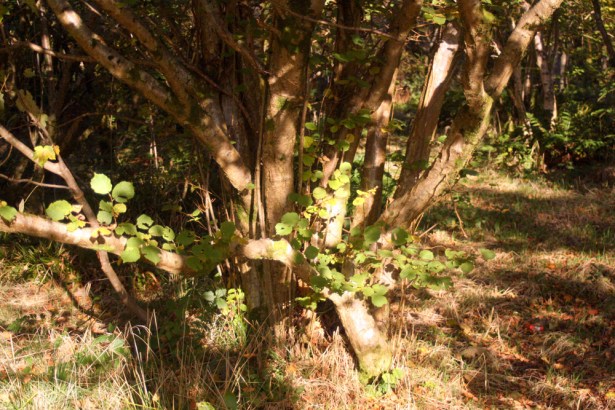
Ooh I almost forgot to mention, they have lovely autumn colour!

Refs:
Flowerdew, Bob, Complete Fruit Book, 1997, page 169.
RHS Encyclopaedia of Gardening, Ed. C. Brickell, 1992, page 387.
Tree Fruit Growing, Raymond Bush, 1962, pages 288-289.
http://en.wikipedia.org/wiki/Mespilus_germanica

Vines in Scotland

Can we grow vines in Scotland?  The small village of Kippen in Stirlingshire ( blink and you’ll miss it ), was the site of a massive vine in the early twentieth century. It was however planted in a heated glasshouse, of the variety Gros Colman.

Almost on the beach in Fife, Christopher Trotter has a small acreage of vines planted , and after 5 yrs he is hoping to get a harvest next summer and produce the first grape wine in Scotland! The varieties he uses are Solaris Rondo and Siegerrebe, both from Northern Europe. It is a gamble to grow vines this far north, but he has chosen hardy varieties recommended by Vineyards in Yorkshire who have learnt a bit by trial and error. And he is in the warmest and sunniest part of Scotland, and who knows what climate change is going to do to us in the next few decades? It may become too dry to grow vines in the south of France one day. I spent last spring pruning organic vines in the south of France. It is amazing how they thrive in very poor stony soil and with no irrigation all summer. The local shepherd was allowed to pass through during the winter, so the ground gets a dose of organic fertiliser. Sulphur sprays were used to keep mildew at bay.


Grape Vine

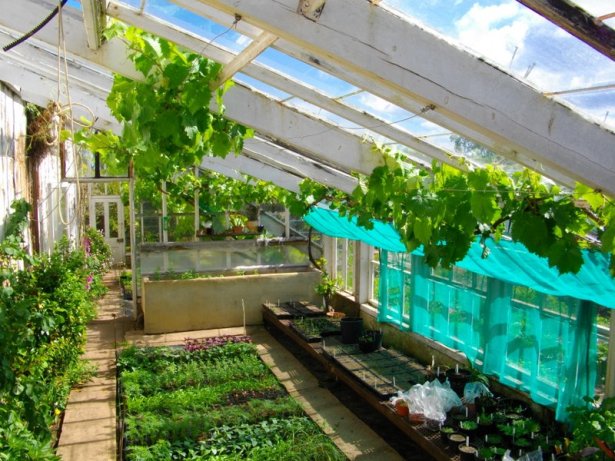
We have a Black Hamburgh grapevine in our glasshouse, and it never fails to give us a good sweet dessert crop as long as we keep the blackbird out when they are beginning to ripen! Somehow he always knows when they are nearly ready before us.It is important to keep the vines cool in winter, they dont like heat all year.

In a Nutshell

In a Nutshell… Set to and brutt your plats!
Some notes on Hazelnuts in Scotland.

The hazel is an important native tree to Scotland (they floated in to the west coast perhaps), and as we sell cobnuts and hazels at Appletreeman, I thought I would put down some notes on their cultivation. Unfortunately there is no information on how to grow them for profit in Scotland, and as most of the UK production is in Kent, and places like Piedmont in Western Italy and Turkey have a thriving hazelnut industry, I have had to glean some notes from old books and European papers. So let’s start with what we do know about their cultivation from these other areas…

We have a Hazel plantation near us, which is productive most years from trees closely spaced and about 25ft tall. They are very vigorous, having lots of ‘’water shoots’’ extending up through their centres to reach the light. The fruit is almost impossible to harvest… we have to wait for them to drop after the Squirrels have had their fill! If we are lucky, there may be piles of nuts surviving under the winter’s blanket of snow. The trees are 14 years old and almost perfect for coppicing now and making use of the rods for hurdle making etc. However they aren’t so good for nut production and collecting.
Corylus_avellana

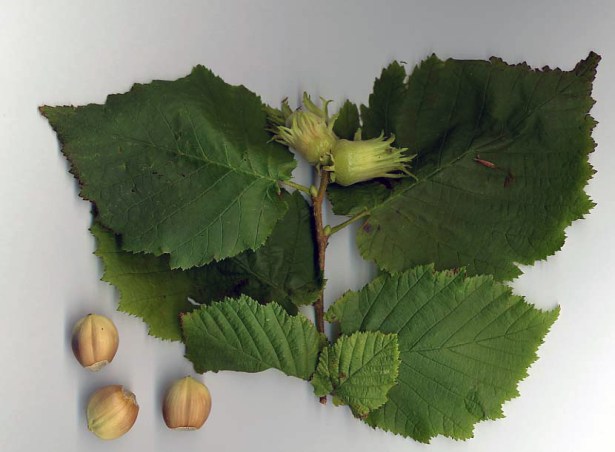
Our native hazel is Corylus avellana. The filbert with its ‘’bearded’’ cover is C. maxima. W.J. Bean lists 10 species, Hillier’s Manual, 8 species. The 2004/5 RHS Plantfinder has 53 entries of species and varieties.They are all native to Northern climes. It is suggested by Bob Flowerdew that these two and C. americana and C. colurna have all interbred to some extent and account for our productive nut clones of today. (see refs. below).

The problem with our local C. avellana for production of nuts is partly due to them being on the very good glacial soils of Tayside, making very vigorous trees, and their close planting drawing them up to the light. So, don’t be too worried about planting on a stony or less favourable soil, though probably avoid wet areas and frost hollows. And don’t crowd them in. A nice well-drained slope with some protection from the East is probably ideal. And they quite like an alkaline soil, though this isn’t essential.

Our local hazels flower very early, sometimes February, usually March. The male catkins are forming, and extending from November, the little red females later. They are wind pollinated, so shaking the branches, or even performing pollination with a little brush on a nice early spring morning is ideal. Of course, you would need reachable branches to do this. Hopefully the male and female flowers will be open at the same time. Our native Hazel must undoubtedly be very hardy, though the non-cropping years are probably due to frost damage. I wonder if we should be investigating late flowering varieties here in Scotland? (See lists below from various authors).
Hazels to coppice at Duchess Woods

Hazels to coppice at Duchess Woods

When you receive a new tree, aim to have a short stem and 5 or 6 branches only. Tie these down or put spacers in to make these fairly horizontal – i.e. make a goblet shape. Any shoots coming up through the centre should be ripped off, and suckers removed also. This may be a continuous exercise every year judging by our local trees. When only 30cm long, allow these framework branches to divide.

So you have achieved a nice open centred tree in the first few years… maintain this framework and head back new growth to keep these trees just above head height so you can pick the nuts. The next stage is to allow lots of laterals to form on your main branches. Strong ones are cut back to two buds, weaker ones may be left. In March, after pollination, cut back the tips of the laterals to a pollinated flower. This is where your nuts will be forming. Then in August, all strong lateral growths are ‘’brutted’’, i.e. the ends are snapped to leave them hanging. This slows down the growth of the tree, lets air in, and puts energy into the nuts. The brutted shoots are cut back in the winter again.

Cross-pollination seems to be important for many varieties and clones, so don’t just buy one tree or variety. Each year try to find another to add to your wee collection. Plant them in a group to aid wind pollination, 4 m apart maximum.

So, in essence it is a bit like pruning a cordon apple tree on each branch if you are familiar with that. A vigorous tree, removed of all excessive growth, and prevented from crowding itself, and having some pollination partners, is the aim. Then there’s the birds, the squirrels and bud mites, and nut weevils to contend with…

Sanders, pge. 58 (see refs) has a good description of the pruning method described above.

Some varieties to look out for:

  • Kentish Cob ( Longue D’Espagne )
  • Webb’s Prize Cob
  • Bollwyller
  • Cosford – thin shelled, good pollinator
  • Pearson’s Prolific ( Nottingham ) – smaller tree
  • Filberts: Red Lambert
  • Trazel (cross between C. avellana and C. colurna) Chinoka and Freeoka.

The Victorians took a good interest in Hazelnuts, and Hogg listed no less than 32 varieties.(pages 426-433 in the 1884 edition). Including the following:

  • Atlas ( C. algeriensis, the Spanish Cob ).
  • Aveline De Provence
  • Barr’s Spanish
  • Bizane
  • Bond
  • Burchardt’s
  • Burn’s ( a grappes precoce )
  • Cannon Ball
  • Cluster ( a grappes )
  • Cosford
  • Daviana
  • Duke of Edinburgh
  • Eugenie
  • Frizzled Hazel ( C. laciniatus )
  • Frizzled Filbert
  • Hartington Prolific
  • Lambert Filbert ( syn Kentish Cob and Webb’s Prize ?)
  • Large Black Fruited ( a gros fruits noirs )
  • Lichtenstein’s
  • Liegel’s
  • Loddiges’ Barcelona
  • Merveille De Bollwyller
  • Norwich Prolific
  • Pearson’s Prolific
  • Primley
  • Prolific Filbert
  • Purple Filbert
  • Striped Fruited ( a fruits Stries )
  • St .Grisier
  • The Shah
  • White Filbert

The National Fruit Collection has Filbert Frizzled, and Kentish Cob, Butler, Ennis

The Kentish Cob Association lists the following trees:

  • Kentish Cob is a reliable cropper, relatively hardy, with excellent flavour. It is recommended for domestic use. It is pollinated by Gunslebert, Cosford and Merveille de Bollwiller, and probably also by wild hazels.
  • Merveille de Bollwiller (also called Hall’s Giant) is a hardy, vigorous and productive variety with large nuts. It is pollinated by Kentish Cob, Cosford, Butler and Ennis.
  • Butler is a large mid- to late-season nut. It is hardy, vigorous and a heavy cropper, and a short-husked variety which de-husks freely when ripe. It is popular for modern commercial production, and is pollinated by Ennis and Merveille de Bollwiller.
  • Ennis is a very attractive large round nut with a superb flavour, but a tendency to produce a significant proportion of blank nuts. It is pollinated by Butler and Merveille de Bollwiller.
  • Purple Filbert (also misnamed Red Filbert) is an ornamental variety with red or purple leaves. It produces a small crop of thin-shelled nuts of excellent flavour but which are particularly susceptible to nut weevil. It is not recommended for nut production.

WJ Bean, Hardy Trees and Shrubs of the British Isle.

  • Corylus spp. listed:
  • americana
  • avellana,
  • chinensis
  • colurna
  • jaquemontii
  • cornuta
  • heterophylla
  • maxima
  • sieboldiana
  • tibetica

Some useful references:

RHS Fruit Yearbook, 1950 by J. Turnbull, pgs 106-109.
Bob Flowerdews’s Complete Fruit Book, 1997, pges 198-199
Hogg, R., The Fruit Manual, 1884. pages 426-433.
Sanders, T.W., Fruit Growing, (no date), pages 55-61 and 215.
http://www.treesforlife.org.uk/tfl.hazel.html
http://www.snh.gov.uk/docs/B850216.pdf
h
ttp://www.forestry.gov.uk/pdf/HazelAwarenessleaflet.pdf/$file/HazelAwarenessleaflet.pdf
http://www.kentishcobnutsassociation.org.uk/a-brief-history-of-cobnuts.aspx

Finally, do hazelnuts float?
http://www.highlandperthshirenews.co.uk/general-landuse-environment/do-hazel-nuts-float

We’d love to hear from anyone who manages their hazels or cobs for their nuts in Scotland.

Salad Days – Seasonally

Don’t get me wrong, I like lettuce. And rocket. I grow prodigious amounts of both, and eat most of it. It’s just that if there is none, I am never lost for salad ingredients. And when there is, I augment the tender crispness of lettuce and the bite of rocket with a host of other favourite ingredients from the garden and hedgerow.

Sorrel on chopping board, image from http://gggiraffe.blogspot.co.uk/2013/05/ww-sorrel-and-lentil-soup.html

In spring and early summer, there is a wide choice of tender green leaves. Garlic Mustard, with big heart-shaped leaves, appears early obligingly self-sown in odd corners of the garden. Mildly garlicky, with a gentle bite of mustard. Our accidental pole of a lime tree (kept as a pole because there’s no room for a tree) produces the most succulent unfurling leaves before any lettuce is ready. Young shoots of Bishopsweed transfer from the weeding bucket to the plate via a good wash. Then the Sorrel family – Common and Buckler-leaf – provide sharp, lemony, bulky leaves – shred them to mix that sharpness through the salad. Sweet Cicely for a hint of aniseed. Rampion, an edible Campanula, produces a mass of tender leaves. Claytonia, or Miners’ Lettuce, which I’ve picked right through winter from the greenhouse bed, is joined by its cousin the Pink Purslane. New leaves of Wood Sorrel, looking like clover but with delicate white flowers, are found in the woods. It’s a refreshing appetiser when nibbled on a walk. For crunchy, succulent foliage, try the long linear leaves of Bucks Horn Plantain – branched at the ends like antlers. Or the round, slightly bitter but always tender leaves of Orpine, a native Sedum whose flowers bring out bees and butterflies in late summer.

As summer progresses, I add sweetly aromatic herbs to the salad bowl, chopping them finely to disperse the subtle aroma and flavour. My favourites are Golden Marjoram, Lemon Balm and Mint – but not just any mint. One of the citrus varieties – Orange, Lime or Lemon Mint, or Basil Mint, or best of all Eau de Cologne Mint. A little goes a long way! Basil itself, of course, contributes a domineering flavour, good with tomatoes. Judicious amounts of Chervil, Summer Savory or Dill with its cucumber tones can all be added. Salad Burnet or young Borage leaves taste similar.

Yellow Primroses, Ramsons from the woods and Cornflower petals are the first edible flowers to be added; later blue comes from borage flowers. Wild Pansies, bright orange Calendula, sweet white petals from my Jacobite Rose and gaudy Nasturtiums taste as good as they look. If I can stand to sacrifice them, I’ll eat Hemerocallis (Day Lily) flowers too, and the ones from my Clove Pinks.

Wild Strawberry

By now, wild strawberries are getting scattered over the salad bowl, and as summer wears towards autumn, fruit starts to dominate. Anything goes. Whole raspberries, blaeberries and whitecurrants; chopped red gooseberries; peaches and grapes from the greenhouses; brambles and elderberries and onwards till I am confronted by the autumn apple mountain – a source of material for my less frequent winter salads.

Nuts go well with apples; wild hazelnuts and walnuts from my neighbours’ tree, well-chopped. Now I will use the pickled ash keys I made in June and other preserves to spice up a winter salad. Greens come from the greenhouse – hardy winter Lamb’s Lettuce, Claytonia and hot Land Cress. Dried fruit, whether home-dried wild strawberries or conventional shop ones, I add liberally.

Salad Days may be over, but salads go on even in the depths of winter, till spring comes round again.

The Tree Nursery in Winter

Appletreeman rarely has a day off in winter! We are still lifting trees for delivery as bare root trees, and this can continue as long as the soil is not frozen solid and when all the trees are sold and delivered of course.  We are also in the process of cutting back 4,000 rootstocks, which are about 1.8m high, to the bottom bud. So there is quite a sizable bonfire to deal with at some stage! This job is done come rain or snow, though a half day is allowed in bad weather.

Appletreeman's Nursery In Winter

Appletreeman’s Nursery In Winter

These stocks were budded (a form of grafting) in August, so we have also been taking the polythene off which has been protecting the bud from drying out. These stocks will then sit as little 10cm high stumps until the bud opens up (hopefully) in May, and forms a new shoot and hence your named apple tree variety.

Budded Tree In January

Budded Tree In January

If only the ground would dry up, we would also be ploughing a new patch of field (we move every year) and be planting our next batch of rootstocks for grafting and budding heritage varieties for 2015. So no winter hibernation here!

Culzean Castle

Those of you who havn’t visited Culzean before are going to be impressed with the Castle’s clifftop view over the Forth of Clyde towards the Isle of Arran. But for me its the tropical feel to the Fountain Garden, the miles of easy paths in the woods to the Swan Pond and beyond, but especially the trees and garden plants in Happy Valley and the Walled Garden that are of interest. Its open 9.30 to sunset each day (well, except the walled garden on New Year’s Day!)

There are Parrotias, Sciadipitys and Myrtles with their beautiful bark to delight in Happy Valley, and a beautiful arch of old Scottish Apples at the back of the walled garden. If you want to see a good selection of Scottish fruit, visit in early autumn.

20140101_140929 (1)

You will find Oslin, Stirling Castle, Bloody Ploughman and East Lothian Pippin here which I planted in about 1992. They have been kept beautifully as cordons, some making strong growth and thick stems, though all were on dwarfing rootstocks.

There are also many fruit trees within the walled garden, including a unique Scottish variety, Culzean Seedling. Also of great interest to fruittreemen (& women) in the walled garden is the enormous Fig tree in the south east facing corner of the wall, which has layered itself along the ground to a large extent. It produces lots of fruit and has to be rigorously controlled each year, such is the advantage of a good wall to plant against. Do visit this gem in West Scotland and enjoy!

Birdseed Bonanza

Goldfinches came to the garden this morning and dithered for ages in front of the window industriously gathering seed from the dead heads of meadowsweet. I was so glad I had not cut them back yet. Nature does not share our compulsion to order and tidiness, so seed-eaters such as finches, buntings and sparrows thrive in neglected gardens like mine. They really appreciate it when we are slow to tidy up and good seed-bearing plants tower gaunt and brown into the winter!

Apart from meadowsweet, I have found goldfinches to be particularly fond of the dead but still fragrant heads of wild oregano, and the copious, fluffy seeds on Hemp Agrimony. This is a tall, stately native plant with big, brush-like heads of purple flowers in late summer and autumn. It likes to grow in damp places but does well in most garden soils. The flowers are much visited by bees and butterflies, making it excellent value for wildlife gardening.

Milk Thistle

Most of the thistle family provide good birdseed once the flowers have faded. Here you will note a conflict of interests – the last thing a gardener needs is weed thistles running to seed in the hope the birds will enjoy them, because for every fattened bird there will be a hundred new thistles choking up your border next spring! However, there are several attractive, non-invasive thistles you can happily allow to run their course – the low growing Carline Thistle, the towering Scots or Cotton Thistle (Onopordon acanthium), or the variegated Milk Thistle for example. Spectacular Cardoons or Globe Artichokes have massive thistly heads which look great even when gone over and will bring in goldfinches and chaffinches. Of course, you might have eaten the globe artichokes yourself, but it’s worth leaving some to feed the birds as well as enjoy the sight of the lovely purple flowers! Globe Thistles are related, but bear spherical heads in blue or white that bees and hoverflies love, and provide substantial seeds when they ripen.

Sparrows, linnets and yellowhammers all enjoy seeds from grasses and cereals, and there are many attractive varieties, from the delicate Golden Millet to the chunky Pampas Grass, which will meet their needs. Seeds from the edible members of the goosefoot, or spinach family are always appreciated – such as Good King Henry, Red Orache and spinach beet that has bolted.

Finally, if you have ever bought wild bird seed you will know that sunflower seed is a big favourite. As the big flowers bend over and the petals fade, don’t bin them! Let the seed gradually ripen for the birds to find. I must admit that I kept banging my head on mine, though, as they keeled over at 45 degrees – a neat and tidy answer was to cut off the heads and hang them to dry from the shed roof, where I expect the Bankfoot Sparrow Gang will eventually decimate them!

© Margaret Lear, Bankfoot. Originally published in Comment, October 2009.

Of Coltsfoot and Liquorice

Yesterday I found the first scaly-stemmed flower of Coltsfoot pushing itself up through the disturbed ground of a plantation in Bankfoot. The plant, also called “Son-afore-the-Father” due to the fact that the flowers appear many weeks before the hoof-shaped, hairy leaves, is a spring herald. It’s particularly welcomed here because by mid-February I have always been caught by one of those coughs that cling to the tail of a winter cold and threaten to sit on your chest for months. This year is no exception.

Coltsfoot leaves and the sunny, dandelion-like flowers are equally useful for treating coughs, though personally I can’t bear to pick the brave flowers and collect and dry leaves all summer instead to see me through. They can be made into a tea, or a decoction. Of old, they have been used in herbal tobacco, too, but it beats me how smoking anything can cure a cough, so I’ll stick to tea. It doesn’t have much flavour, so I add evergreen thyme (also good for coughs!) in winter, and in summer a few leaves of mint, lemon balm or meadowsweet. Fresh coltsfoot leaves can also be used as a vegetable and even yield a yellow-green dye.

This winter, thanks to an excellent evening class in herbal medicine I have discovered another cough-soothing delight – liquorice.  I have never liked liquorice allsorts, and for all I respect the monks of Pontefract, their “cakes” and the long tradition of growing and processing liquorice in that district, NOTHING would have persuaded me to chew liquorice root if I’d known what it was. But the unprepossessing and rock-hard root is something else entirely. The flavour is sweet and delicate; I’ve been boiling chopped root for ten minutes, then adding coltsfoot leaves. On Bad Throat Days, in goes a spoonful of honey from my bees too. Liquorice has been used medicinally for over three thousand years, for constipation and stomach ulcers as well as bronchial complaints. It’s a substance called glycyrrhizin in the roots, sweeter by far than sugar, which accounts for its use in confectionery. I don’t know which bit makes foam, but it’s also used in fire extinguishers!

Coltsfoot is best gathered in the wild unless you have a large garden – it spreads most obligingly. Liquorice, a native of south-eastern Europe, is slow to germinate, the seeds are expensive, and it will take a while to produce worthwhile roots. But it has pretty foliage and pea-like flowers to enjoy while you are waiting, so is well worth growing.

Today, five inches of snow covered 2005’s first coltsfoot, and I’m still coughing, so spring had better get a move on. The hedgerow pharmacy is in demand!

© Margaret Lear, Bankfoot. Originally published in Comment, March 2005

Dancing with Faeries…

I am not a great enthusiast for lawns. Nothing against grass, you understand, and even when mown and edged it has its place – for picnics, sunbathing, throwing sticks for the dog, and so on. But the lawn is not exactly exciting, is it?

Faery Ring

Unless something Goes Wrong with it. To some people, the sudden appearance of circular, dark green patches on the lawn is Something Going Wrong. And it may be – the circular patch becomes a ring, and in some disturbing cases a double ring, with fungi on the outer edge for a brief time, and dead grass (soon followed by weeds) in between the rings. This is the worst scenario, and most people just see dark green rings and, often, no fungi at all.

These rings were noticed in meadows and pastures centuries ago, and largely attributed to the pattering feet of faeries dancing round in circles. Belief in “other” folk was commonplace and accepted, as was the presumption they could do some harm if crossed.

There is an old Scottish rhyme which sums it up:
“He wha tills the fairies’ green,
Nae luck agin shall hae,
And he wha spills the fairies’ ring,
Betide him want and wae,
For wierdless days and weary nights
Are his to his deein’ day!”

The more rational (or less imaginative) put the phenomenon down to lightning, the feeding of cattle or the mating rituals of moles. The fungi sometimes seen were thought to grow on the slimy trails of slugs attracted to the greener grass. In fact, as we now know, the fungi CAUSED the faery rings.

Think about it. Nearly all fungi grow outwards in a circle from a starting point. Penicillin mould on bread. The way an apple rots, with concentric rings of fungus. That fungal skin disease isn’t called RINGWORM for nothing! Below the soil, the perennial mycelium (“roots”) of the fungus grows silently outwards. Mushrooms (toadstools if you prefer) are produced on the outer edge of the ring when conditions are right – not necessarily every year. The mycelium consumes carbohydrates and proteins in the soil as it advances, and converts some of it to ammonia, which is then converted to nitrates by bacteria. Nitrates – yes, the basis of “greening up” lawn fertilisers. No wonder there’s a dark green ring! But with some species, such as the Fairy Ring Mushroom (Marasmius oreades), which is delicious but tricky to identify safely, the mycelium grows so densely in the soil it forms an impermeable layer of fibres, through which rain cannot penetrate. The grass behind the ring dies. Eventually, so does the mycelium. And as the grass and the fungal remains decompose, they in turn yield nitrogen – feeding the grass behind and forming an inner ring.

Year on year, the ring gets wider and wider, until we are scarcely aware of it. You may find Parasol Mushrooms (Lepiota), Field Mushrooms (Agaricus), Puffballs (Clavaria and Lycoperdon species) and many other edible species growing in rings – and quite a few non-edibles too! The most exciting one I ever found was as a teenager at the very start of my obsession with fungi, researching for my college project. It was a MASSIVE ring in dense woodlands, of the Giant Funnel-cap, Leucopaxillus giganteus, a species of edible mushrooms each a foot across, all glowing an eerie white in the gloom. This species can mither about below ground for half a century before producing mushrooms, so I was enthralled and very lucky.

I went home and promptly wrote a faery story…

© Margaret Lear, Bankfoot. Originally published in Comment, September 2011

Gently Fermenting

I have mentioned before how in autumn my house fills with apples and pears, none of which I am allowed to touch until they have been marched off to apple days, conferences or shows. By which time they get a bit past it, and people start asking where I got the cider-flavour air freshener.

Cider-press

We are getting better at it. The construction of a lean-to back shed with shelves for trays of apples, and the brilliant but hitherto strangely overlooked option of turning off the heating in one room and closing the door, slow down the rot. So we are likely, even in this year of poor productivity, to have a fair few fruit to process in a couple of weeks.

The first option, after eating the ripe ones and storing the most sound of the slightly unripe, will be to juice them. Some apples and pears are quite dry, and juicing shouldn’t be attempted unless you have a real stack of them – let them ripen first. Others are just made for juicing, and a couple of carrier bags full will yield a gallon of pure juice. Mostly, a mixture of varieties is best – and don’t worry about including cooking apples. Once juiced, they are sweet and full of flavour.

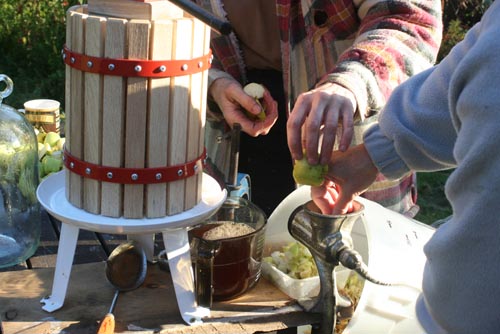
The apples must be washed, and any seriously rotten bits cut out. If the fruit is straight off the tree, we think a cursory hose down is plenty of hygiene! We borrow a big electric crusher and throw the apples in whole – if you are using a hand crusher, it’s best to cut them in halves or quarters first. First year we juiced, we used a meat mincer. It worked, but slowly! The crushed fruit is then placed in the press wrapped in coarse sacking-like cloths. As the pressure is applied, juice starts to run freely – don’t forget the bucket to catch it in! It is ready to drink – you add nothing and take nothing away. We bottle the spare in small plastic bottles or old drinks cartons and put it in the freezer. However, you can refine it if you wish. Pure fresh apple juice is usually brown (due to tannin in the apples) and cloudy. Leaving it overnight sometimes clears it completely and you can siphon the clear juice off the sediment. If this doesn’t work, you can try adding the enzyme pectolase, which should clear the pectin that causes haziness. I’ve never known this to work well, and nor does filtering! If you haven’t much freezer room, you can pasteurise the bottles of juice by placing in a vat of cold water, raising the temperature to 70 degrees and keeping it there for 20 minutes.

Left alone, the juice will start to ferment within days. Wild yeasts work on the fruit sugars to turn them to alcohol – cider. Cider made accidentally this way can be superb – or appalling! If we want to ferment our juice we try to be a little more scientific. This means adding Camden tablets to kill off undesirable microbes that would taint it. This also kills the wild yeast, so we have to add some more. We make sure air is excluded completely, first with cotton wool, then an airlock. After a few days, fermentation is dramatic, and calms down after a few weeks. When it’s about stopped, we siphon the cider into lemonade bottles, with a teaspoon of sugar. This sets off a wee secondary fermentation, giving us a sparkling cider when we open the bottles at Christmas!

Our cider is nothing like shop-cider, and probably too dry and sour for some. It’s always unpredictable, because we are using a different mix of apples each time. We’re growing some proper cider apple trees, but for now, we are very happy to experiment and see what it turns out like – it’s all part of the fun of Appletreewidowhood!

© Margaret Lear, Bankfoot. Originally published in Comment, October 2012