Culzean Castle

Those of you who havn’t visited Culzean before are going to be impressed with the Castle’s clifftop view over the Forth of Clyde towards the Isle of Arran. But for me its the tropical feel to the Fountain Garden, the miles of easy paths in the woods to the Swan Pond and beyond, but especially the trees and garden plants in Happy Valley and the Walled Garden that are of interest. Its open 9.30 to sunset each day (well, except the walled garden on New Year’s Day!)

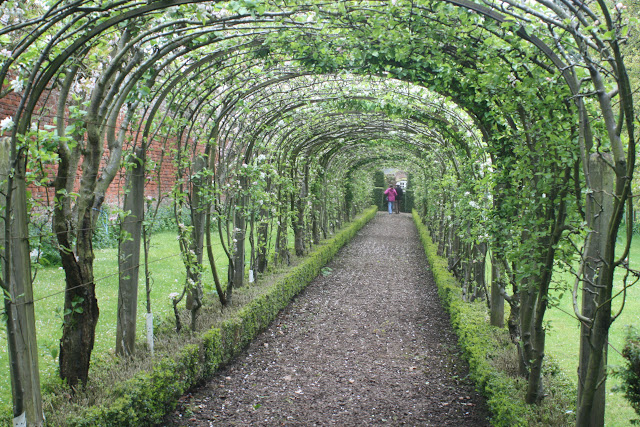
There are Parrotias, Sciadipitys and Myrtles with their beautiful bark to delight in Happy Valley, and a beautiful arch of old Scottish Apples at the back of the walled garden. If you want to see a good selection of Scottish fruit, visit in early autumn.

20140101_140929 (1)

You will find Oslin, Stirling Castle, Bloody Ploughman and East Lothian Pippin here which I planted in about 1992. They have been kept beautifully as cordons, some making strong growth and thick stems, though all were on dwarfing rootstocks.

There are also many fruit trees within the walled garden, including a unique Scottish variety, Culzean Seedling. Also of great interest to fruittreemen (& women) in the walled garden is the enormous Fig tree in the south east facing corner of the wall, which has layered itself along the ground to a large extent. It produces lots of fruit and has to be rigorously controlled each year, such is the advantage of a good wall to plant against. Do visit this gem in West Scotland and enjoy!

Tyninghame Gardens and Orchards

I have just visited a very important and very well maintained fruit garden in East Lothian and thought a wee report was needed! It opens under the Scottish Gardens Scheme twice a year.

There is evidence that, by the 12th century, Tyninghame was a Monastery served by Lindisfarne, but also that St Baldred was there in the 8th century. As in many areas of Scotland, fruit and medicinal plants would have been grown by the monks, and the tradition continues here today. The Bishop’s of St Andrews used the site also.

Tyninghame Gardens and Orchard. Photo by Appletreeman. www.plantsandapples.co.uk

In 1628, the !st Earl of Haddington acquired the property, which remained in the family until 1987. He and his wife planted many trees and tamed what was an open wild landscape.

The lovely red sandstone of the house was added by William Burn in 1828.

The walled garden dates from 1750, and had heated walls originally. It is some distance from the big house and there are restored glasshouses with figs, peaches and vines.

Tyninghame Gardens and Orchard. Photo by Appletreeman. www.plantsandapples.co.uk

The 12th Earl and Lady Sarah formed much of what we can see today – post war they started to remodel the walled garden from one employing 8 gardeners by changing it to an ornamental one. He died in 1986.

The last 50 years saw low maintenance as the order of the day, with an arboretum planted, and annuals replaced by roses in the secret garden, and many borders grassed over, but luckily some old apples remain in the walled garden. These old ones are ow standards and several are propped to keep them up; a fine younger orchard in the north west corner has some exciting old Victorian varieties. Here can be found dessert fruit of King of the Pippins, a golden pippin / cox cross, Cellini,
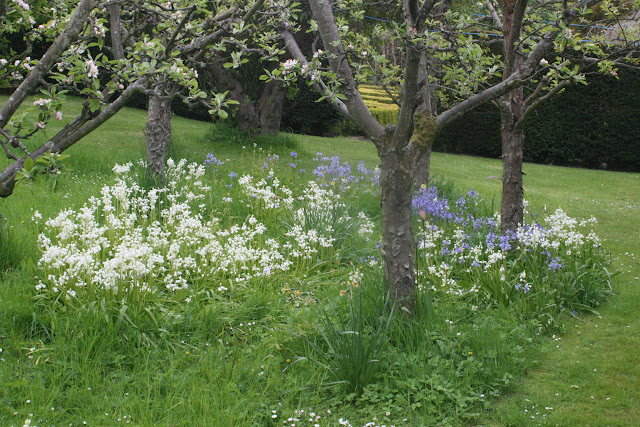
Laxton’s epicure and exquisite, a Cellini / Cox hybrid. Epicure is a wealthy / cox cross – I think someone liked their Cox apples! These are set in long grass with patches of bluebells. Devonshire Quarrenden, an early flat crisp apple, can be found within a boundary of old espaliered trees, nicely set within the gravel.

At the north end of the walled garden is apparently what used to be an apple store.

Tyninghame Gardens and Orchard. Photo by Appletreeman. www.plantsandapples.co.uk

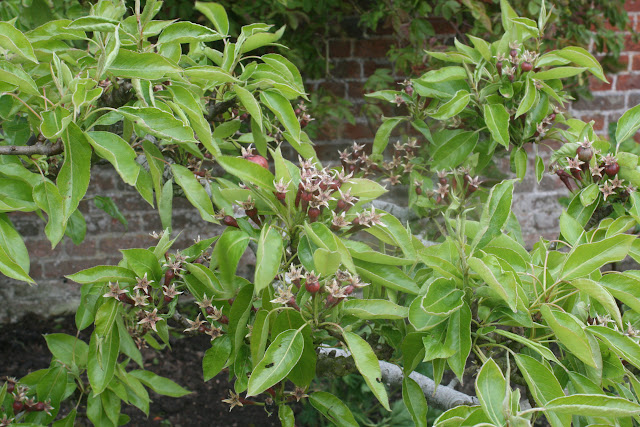
A very productive Louise Bon De Jersey pear lines the west facing wall, with golf ball sized fruits in May, and some Victoria plums form the centre of an ornamental display. Two small medlars on quince rootstocks stand near the gate to the Apple Walk. This is outside the south wall and is of cordons over a substantial post and wire arch. Many varieties here, but indiscernible except for labelled Discovery and Allington Pippin. Many appear to have been grafted in situ, with lots of
woolly aphid and canker. This may be a result of the considerable shading of nearby trees.

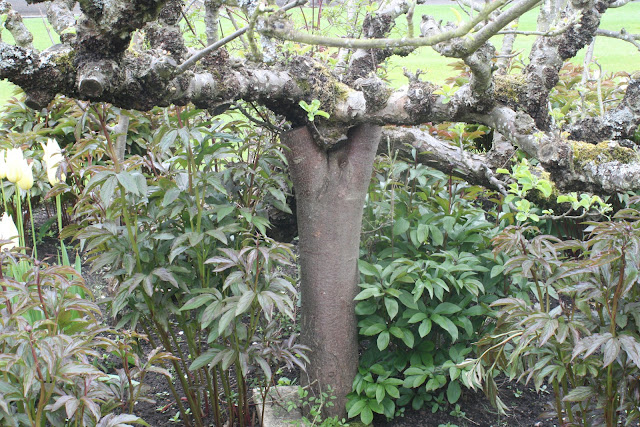
The apple walk in the secret garden, originally under-planted with pheasant eye narcissisi, blue grape hyacinths and geraniums, has almost gone, only a few standards remaining. A fine big Malus floribunda overhangs this area. These old trees may have been the apples trees that supplied the scions for the collection of Scottish varieties sent to the National Fruit Collection in 1949 by a Mr Brotherston, the head gardener.

Tyninghame Gardens and Orchard. Photo by Appletreeman. www.plantsandapples.co.uk

The following varieties were saved for posterity by Mr Brotherston in 1949:

  • Leathercoat Russet
  • Yorkshire Aromatic
  • Small’s Admirable
  • Love Beauty
  • Liddell’s Seedling
  • Lass o’ Gowrie
  • Lady of the Wemyss
  • Green Kilpandy Pippin
  • East Lothian Pippin
Tyninghame Gardens and Orchard. Photo by Appletreeman. www.plantsandapples.co.uk

Many thanks to Chas and Albert, current and retired head gardeners who have done a fantastic job of maintaining this lovely garden.

Alexander and Brown, Perth

Alexander and Brown were very famous seedsmen in the High Street, Perth, supplying plants, bulbs and seeds to uk and continental customers. They were in business from 1897 to 1981, when they were taken over by W. Smith & co. of Aberdeen. Alfred Bown was born at Montrose, and was originally apprenticed to Dickson and Turnbull ( of Perth Nurseries) in 1897 before joining Alexander. They produced a catalogue every couple of years, and their vegetable seed list is most interesting, but Appletreeman’s main interest is where they got their ‘English grown’ fruit trees from and who they were supplying locally.

They started putting English grown fruit in their catalogue from around 1901. The varieties they sold were:

Apples

  • Arbroath Oslin
  • Beauty of Moray
  • Bismark
  • Blenheim Orange
  • Bramley’s seedling
  • Codlin Keswick
  • Court of Wick
  • Cox’s Orange Pippin
  • Devonshire Quarrenden
  • Duchess of Oldenburgh
  • Dumelow’s Seedling
  • Early Harvest
  • Ecklinville Seedling
  • Emperor Alexander
  • Golden Spire
  • Lady Sudeley
  • Hawthornden ( old ).
  • Kerry Pippin
  • King of the Pippins
  • Lane’s Prince Albert
  • Lord Derby
  • Lord Grosvenor
  • Lord Suffield
  • Mank’s Codlin
  • Northern Dumpling
  • Peasgood’s Nonsuch
  • Ribston Pippin
  • Reinette du Canada
  • Stirling Castle
  • Tower of Glamis
  • Warner’s King
  • Worcester Pearmain

”….other varieties can be had on application……”

Pears

  • Bergamont Gansel’s
  • Beurre Bachelier
  • d’amanalis
  • D’Aramberg
  • Diel
  • Rance
  • Bon Chrétien ( Williams )
  • Bishop’s Thumb
  • Clapps Favourite
  • Colmar
  • Crawford Early
  • Glou Morceau
  • Doyenne d’Ete
  • Hessel
  • Jargonnelle
  • Louise Bonne of Jersey
  • Marie Louise
  • Moorfowl Egg
  • Passe Colmar
  • Swan’s Egg
  • Thompson’s
  • Vicar of Winkfield

Plums

  • Belle de Septembre
  • Coe’s Golden Drop
  • Czar
  • Damson
  • Early Prolific, River’s
  • Gage, Blue
  • Green
  • Oulin’s Gold
  • Purple
  • Jefferson
  • Kirke’s
  • Magnum Bonum, Red
  • White ( White Mogul )
  • Orleans
  • Early
  • Pond’s Seedling
  • Prince Englebert
  • Reine Claude de Bavay
  • Sharp’s Emperor
  • Victoria
  • Washington

Quite an impressive list! It is very likely that these varieties survive in the older gardens of Perthshire today. Let me know if you think you have one!

David Douglas

David Douglas was born in 1799 at Scone and went to school at Bridgend., as he got kicked out of his first school. There’s a plaque on the wall next to the Isle of Skye Hotel commemorating the life of this son of Perth. He worked for the Earl of Mansfield as an apprentice, and it appears his abilities were soon recognised as he journeyed at an early age to a garden in Fife, and later to Glasgow Royal Botanic Garden.

He was chosen by the Horticultural Society ( now Royal ) to collect plants and specimens of interest from America. He boarded the Ann Maria bound for New York at Liverpool on 5th June 1823, only to find the tide was too low for them to move so he took the opportunity to botanise on land for the day! What a man! Eventually weighed anchor on the 6th and made the journey across the Atlantic to Long Island which was sighted on 31st of June, where he spent the next 5 months collecting plants and sending specimens back to the Horticultural society in London.

The woodland landscape of Perthshire today is partly as a result of Douglas and other botanists sending home conifers from far flung places of the World. Of particular interest to appletreeman is his interest in vegetables and the orchards of the New World.

One of his first observations was the orchards on Long Island! He went to the Vegetable Market, The Fulton, on the 10th and observed an immense variety of plums, and early damsons. Also an abundant supply of pears, peaches and apples. On the 12th he crossed the Hudson to see more fruit orchards, including a Dutchman with 20 acres of peaches and 24 varieties! This man grew rootstocks from seed and budded them in August just like we do today!

David was impressed with Plum Washington which Dr Hossack procured for him. At Burlington on the 20th, David met W. Coxe, who was busy with a cider harvest! On the 23rd he visited Philladelphia’s market, which he thought better than New York’s.

Mr Hogg looked after many of the plants he procured on his travels. He put some osage apples in spirits. Back near New York on the 2nd Sept he saw some Seckel Pears, and an Isabella Grape 75 feet long. He visited West Point and observed more fruit, and then boarded the Richmond steamboat to Albany. What did he do first..yeah visited the Veg Market!

On the way to Little Falls he observed cider presses and orchards everywhere. Mostly apples and a few varieties of plums. He found a place called Caledonia and full of Scots! On the River Detroit he found a wild pears growing and in the old French settlements he saw 8 to 10 varieties of apples called red, white and black. Also pears, probably brought in from France by the immigrants in the previous century.

He found a large and tasty crab apple near Amherstburg. Is this the place Patrick Sinclair set up? He planted an orchard there apparently to supply his troops.

It was at this point that David’s assistant ran off with his stuff when he was up a tree, and when he got down he couldnt control the horse because he couldnt speak French! You couldn’t make it up. He then worked his way to Niagara and Canada, and found the ‘Pound Pear’ being grown. Also Magnum Bonum Plum (egg plum), Blue Orleans and Washington. Also Black Prince and Hamburgh vines.  Then to Rochester and Albany and observed more vines, White Sweet Water, Grizzly Fontignan and Malmsey. Apples and Pears but Plums faring better.

On his travels in Burlington, he got two bottles of cider, one made from wine-sop, the other Virginian Crab apple. On Nov. 14th he went to another veg market (Amboy?), searching for unusual varieties.  On the 12th december he boarded the Nimrod, bound for Great Britain. He had quail, pigeons and ducks ( who were sea-sick), as well as his plants and specimens!

What a rampage he had in the Eastern States of the US!

References: The Plant Hunters , by Charles Lyte, Orbis, 1983 and Journal of David Douglas originally published in 1914 by William Wesley and Son, London.

David Douglas

David Douglas was born in 1799 at Scone and went to school at Bridgend., as he got kicked out of his first school. There’s a plaque on the wall next to the Isle of Skye Hotel commemorating the life of this son of Perth. He worked for the Earl of Mansfield as an apprentice, and it appears his abilities were soon recognised as he journeyed at an early age to a garden in Fife, and later to Glasgow Royal Botanic Garden.

He was chosen by the Horticultural Society ( now Royal ) to collect plants and specimens of interest from America. He boarded the Ann Maria bound for New York at Liverpool on 5th June 1823, only to find the tide was too low for them to move so he took the opportunity to botanise on land for the day! What a man! Eventually weighed anchor on the 6th and made the journey across the Atlantic to Long Island which was sighted on 31st of June, where he spent the next 5 months collecting plants and sending specimens back to the Horticultural society in London.

The woodland landscape of Perthshire today is partly as a result of Douglas and other botanists sending home conifers from far flung places of the World. Of particular interest to appletreeman is his interest in vegetables and the orchards of the New World.

One of his first observations was the orchards on Long Island! He went to the Vegetable Market, The Fulton, on the 10th and observed an immense variety of plums, and early damsons. Also an abundant supply of pears, peaches and apples. On the 12th he crossed the Hudson to see more fruit orchards, including a Dutchman with 20 acres of peaches and 24 varieties! This man grew rootstocks from seed and budded them in August just like we do today!

David was impressed with Plum Washington which Dr Hossack procured for him. At Burlington on the 20th, David met W. Coxe, who was busy with a cider harvest! On the 23rd he visited Philladelphia’s market, which he thought better than New York’s.

Mr Hogg looked after many of the plants he procured on his travels. He put some osage apples in spirits. Back near New York on the 2nd Sept he saw some Seckel Pears, and an Isabella Grape 75 feet long. He visited West Point and observed more fruit, and then boarded the Richmond steamboat to Albany. What did he do first..yeah visited the Veg Market!

On the way to Little Falls he observed cider presses and orchards everywhere. Mostly apples and a few varieties of plums. He found a place called Caledonia and full of Scots! On the River Detroit he found a wild pears growing and in the old French settlements he saw 8 to 10 varieties of apples called red, white and black. Also pears, probably brought in from France by the immigrants in the previous century.

He found a large and tasty crab apple near Amherstburg. Is this the place Patrick Sinclair set up? He planted an orchard there apparently to supply his troops.

It was at this point that David’s assistant ran off with his stuff when he was up a tree, and when he got down he couldnt control the horse because he couldnt speak French! You couldn’t make it up. He then worked his way to Niagara and Canada, and found the ‘Pound Pear’ being grown. Also Magnum Bonum Plum (egg plum), Blue Orleans and Washington. Also Black Prince and Hamburgh vines.  Then to Rochester and Albany and observed more vines, White Sweet Water, Grizzly Fontignan and Malmsey. Apples and Pears but Plums faring better.

On his travels in Burlington, he got two bottles of cider, one made from wine-sop, the other Virginian Crab apple. On Nov. 14th he went to another veg market (Amboy?), searching for unusual varieties.  On the 12th december he boarded the Nimrod, bound for Great Britain. He had quail, pigeons and ducks ( who were sea-sick), as well as his plants and specimens!

What a rampage he had in the Eastern States of the US!

References: The Plant Hunters , by Charles Lyte, Orbis, 1983 and Journal of David Douglas originally published in 1914 by William Wesley and Son, London.