
#appletreeman Fortune, Sunset,Boskoop,Worcester,George Cave &Tower of Glamis good but James Grieve doing best again pic.twitter.com/v52fjZTHnE
— Andrew Lear (@plantsandapples) June 16, 2014
Author: Lynsey Payne
Spindlebush Apple Trees
The Spindlebush Method of Growing Apple Trees
Some of the small apple and plum trees i left in the field after i moved my nursery two years ago ( I move to a new patch every year), started to fruit this year in earnest. At the moment they have central leaders and i have the option of letting them branch out with 5 or 6 framework branches, and later cut out the leader to form open centred trees. This is an easy method of formative shaping to understand for amateurs and semi-professionals.
However, with the advent of dwarfing rootstocks, in the early 1940’s in Germany, and later in Holland, the growing of high density spindlebushes was becoming of great interest to growers. We in the uk were still growing very large trees on M7 rootstocks at a very wide spacing, and it was only post – war visits to Germany which opened our eyes to developments there.
So here are a few jottings on the subject:
So what are spindlebushes?
Its similar to my cordon grown trees, in that it is all about having fruiting wood in abundance and basically nothing else! Those of you who have attended my workshops will be familiar with the need to identify fruiting wood.
Its advantages are as follows:
Very high rates of production per hectare.
Small trees, enabling pruning, spraying and harvesting from the ground.
Very efficient use of land and available sunshine.
They are normally grown on very good land, and M9 rootstocks, a very dwarfing one. Basically, there is a central stem and lots of wee laterals to carry the fruiting buds. A tall thin pyramid is required. Thicker pencil sized laterals are cut back to 4 buds, anything thinner to 2 or 3 buds. Cut to downward facing buds always. So horizontal wood is the aim, use spacers if necessary. Unlike some methods I teach, this one requires very severe pruning. The leader is pruned – that is the new growth to 4 or 2 buds on a weak tree.
The common mistakes are to not cutting back the leader hard enough and allowing too much fruit early on leading to stunting of shoots. The aim is to have lateral branches with lots of fruiting spurs and no gaps along the branches.

Fruit from my 2 year spindlebush tree
In late July, the new growth from the stubs are tied down to form horizontal fruit wood. Be careful not to droop the ends below horizontal if possible. Prune back all sub-laterals in summer
(‘Lorette pruning’), or next winter if you forget! You can allow your laterals to branch to fill the space a little, such as if theres a gap in your tree you want to fill. Tie a higher one down to fill a space if necessary. Keep the pyramidal shape by pruning harder if necessary your top laterals. Each tree should yield 10 lbs of fruit by the 4th year. The original spacing recommended was 10 feet ( 3m) and 435 trees per acre. In you have an acre, you could be producing 4.3 tonnes of fruit by your 4th year! Using an m26 rootstock in most areas of Scotland, and tieing to stakes or wires in North-South lines is probably ideal. A modification is the Tall Spindle, which is allowed to grow to 3m and planted 1m x 3m spacings. It must have up to 10 short feathers ( branches) already from the nursery. Visit your nurseryman and select your trees personally!
If you want to know more about pruning workshops, please see our google calendar on the website http://www.plantsandapples.co.uk.
References:
Wertheim, S.J., The Training of the Slender Spindle of Four Apple Varieties. Nov. 1970
Golschmidt and Delap, The Spindle Bush Method of Growing Apple and Pear Trees, The RHS Fruit Yearbook, 1950, pages 54-66.
The RHS Encyclopaedia of Gardening , ed C. Brickell, page 380.,1992.
Fruit trees and Frost
Frost protection of Fruit
All gardeners are aware of the dangers of frost on young opening leaves and flowers of many types of fruit in spring. An orchard owner in the Clyde valley told me the story of how his father used to light barrels of oil under his plum trees on frosty nights! And in the late 50’s wind pumps and heaters were being used in some countries. The 2012/13 winter in Scotland was very prolonged, but it turned out to be very beneficial.The apple blossom was almost a month later than usual, missing damaging frosts, and many varieties flowered at the same time. The effective pollination period was thus very short but very effective! The harvest of 2013 was superb! its the more usual erratic springs which cause us the problems.
Our main worry is the early frosts catching Oslins and Scots Dumplings, and the late frosts in mid-May which can destroy the later flowering Worcester and Cambusnethan trees chance of fruit.
How do professionals overcome this?
1-The best answer of course is not to plant your trees in risky areas such as frost hollows or the bottom of slopes.
2-Secondly, choose known hardy varieties for your area, i.e. not fruit that is grown widely in the warmest areas of France or the South of England. Hardy varieties have been bred and are grown in places like Poland, Norway and Canada, and some well known British varieties are very hardy: Keswick Codlin, Golden Spire, Emneth Early for example. We are actively propagating a few very hardy Swedish and Norwegian summer apples…so look out for them in our catalogue.
3-Thirdly, you may try to cover your trees on frosty nights with fleece or blankets. I tried this one winter, but realised that a lot of buds get damaged in the process of constant removal – you have to let pollinating insects in to do their work every day!

Some experiments in the 1950’s proved that covering is ineffective by and large. They tried using an electric heater and running a hose every 15 minutes over the branches. By far the most effective treatment was to provide a fine mist spray over the flowers as the temperatures dropped. In essence, the water prevents the temperature of the flowers going below freezing by latent heat of evaporation.
These spraying experiments, by JH Jeffree ( RHS, 1950), resulted in achieving a good crop on adjacent sides of two apple trees that were receiving spray. The far sides of each were bare of fruit come the summer! The effectiveness of, and the spray coverage, was improved by using a rotating spray head on a long pole.
If you want to try this next spring, be aware that a lot of ice can form on the twigs and branches so watch they don’t break under the weight! A few props for the weaker branches may help. You may need to be doing a few night shifts from early April to mid May this year!
References
Jeffree,J.H., 1950, RHS FRuit Yearbook, 1950.pages 100 -104.
Some notes can also be found on : http://hos.ufl.edu/extension/stonefruit/frost-protection-orchards-0 and http://ucce.ucdavis.edu/files/repositoryfiles/ca1208p4-64660.pdf and also:
http://fruitgrowersnews.com/index.php/magazine/article/protecting-your-fruit-from-frost-and-freeze
Quinces in Scotland
We occasionally have available for sell the following Quinces: Vranja, Meech’s Prolific, Serbian Gold Smyrna and Portugal and are often asked how well they do in Scotland.Here are some notes gleaned from various articles and personal experience.
The quince, Cydonia oblonga, famous for Cotignac and Marmalade, is a tree that can grow to 4 or 5m. It is probably native to Central Asia and the near East ( WJ Bean, 1970), but has been cultivated for many centuries. They were much esteemed in Italy, and Sanders suggests the Romans introduced them to Britain, and they reputedly grow wild in Sussex. Today they are still highly esteemed from southern Europe to as far as South America.In France they are called ‘Coins’.
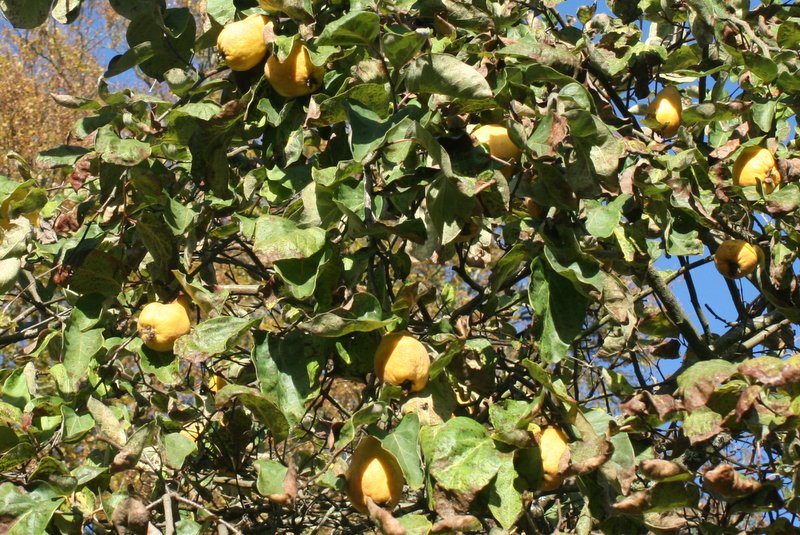
Quinces on a tree in North Fife Autumn 2013
It forms a rather scruffy bush or small tree, with a multitude of intertwining branches if not pruned. Autumn leaf colour can be very nice. They need a bit of cold in winter to promote flowering.
Hogg (1886) surprisingly only mentions apple shaped, pear shaped or Portugal types and no record of Victorian varieties. Bean names the Portugal variety as ‘Lusitanica’, Maliformis’ as the apple shaped and only two cultivars, Vranja and Bereczki.
Angers quince A , B and C are two selections used for producing dwarf pear trees.
Flowerdew lists the following:
The Portuguese: Pear shaped, vigorous, but slow to crop.
Vranja: ( Bereczki) From Serbia, large fruited, pear shaped erect growing tree.
Meech’s Prolific: Pear shaped, early to bear and late keeper. This comes from USA.
Champion: Round, mild flavoured.
Isaphan and Maliformis, are mentioned, and Orange, Pineapple and Smyrna occur in the US.
Importantly he mentions they are self-fertile though others suggest cross-pollination improves fertility. They flower in June in this country, a big open flower, white or pink. They are generally grown as a low standard / bush tree. I have rarely seen then pruned or trained in Scotland, but there is no reason why they cannot be trained to whatever shape you want. There is a garden in Church Stretton which has a wall topped with a pleached quince ‘’hedge’’. This proves that they can be trained! So ok to train them up a wall or fence.
Frequently quince bushes can appear from the rootstock of a pear that has died – though i have not seen any fruit on these.
Quinces can be entirely left to their own devices, but ideally trees should regularly have some of the internal branches taken out to reduce the amount of congestion. Sunny, warm, and well-drained sites are preferred, avoid cold frost pockets.They are susceptible to leaf blight, especially any overgrown rootstocks, but larger specimens seem to be more resistant in Scotland.
40 years ago in South America school children were given Quinces for their packed lunch, which they ate raw with salt! However, in our climate they are generally used for jelly, jam or ‘cheese’.They are highly aromatic when ripe, and can be stored to ripen if necessary.
Other varieties available from UK Nurseries include Akvambari, Ekmek, Isofahan, Sobu, Seibosa, and Shams from Turkey and Iran.
Quinces are easy to grow, and looked beautiful when the fruits are ripening to a lovely lemon yellow on the tree. There are good examples around Scotland, notably St Andrews botanic gardens, and a private garden in North East Fife. A warm wall is likely to be beneficial to the ripening of fruit, or at least some shelter. When all the apples and pears have been picked, watch out for birds attacking them. Bordeaux mixture may be required if leaf blight takes hold
( Entomosporium maculatum).
The RHS suggest pruning all leaders on new tree to outward facing buds; this would promote a more open and wider bush. Allow at least 3 m between trees ideally.
The fruit is highly aromatic and can be used in small quantities to flavour apple pies etc.
The following varieties are listed in Wikipedia:
- The ‘Bereczcki’
- ‘Champion’
- ‘Cooke’s Jumbo’ (syn. ‘Jumbo’)
- ‘Dwarf Orange’
- ‘Gamboa’
- ‘Le Bourgeaut’
- ‘Lescovacz’
- ‘Ludovic’
- ‘Maliformis’
- ‘Meeches Prolific’
- ‘Morava’
- ‘Orange’ (syn. ‘Apple quince’)
- ‘Perfume’
- ‘Pineapple’
- ‘Portugal’ (syn. ‘Lusitanica’)
- ‘Siebosa’
- ‘Smyrna’
- ‘Van Deman’
- ‘Vrajna’ (syn. ‘Bereczcki’)[6]
There are 16 entries in the RHS Hardy Plant Finder under Cydonia. Portugal is the probably the best quality but not so easy to grow here. Vranja and Meech’s Prolific, Smyrna and Serbian Gold are likely to be the more reliable here. They are easy to grow in any sheltered place in Scotland so why not give them a try?
Appletreeman would be very interested to learn of any unusual varieties you have successfully grown or your experiences with quinces in Scotland? email@plantsandapples.co.uk
refs:
Hogg’s Fruit Manual, 1886.
Flowerdew, Bob, Complete Fruit Book, 1997.
Bean WJ, revised 1970 ed. Trees and Shrubs Hardy in The British Isle.
Encyclopeadia of Gardening, RHS, 1992, Page 386.
Sanders, T.W., (1946?) Fruit and Its Cultivation, page 123. http://en.wikipedia.org/wiki/Quince_cheese
RHS Hardy Plant Finder 2004-2005.
Apple Trees and Flooding
Many of you will be planting new fruit trees this spring and will be wondering what effect all the rain will have on your trees. At present your trees are dormant and most likely you are planting them as ‘bare root’. It is well known that up to 90% of your trees roots may be killed when they are lifted out of the nursery and replanted, so it is very important you keep the roots moist and frost free to preserve what’s alive.
Tree roots need oxygen, and prolonged wet conditons will create anaerobic conditions and many more roots will suffocate. In spring, your trees will have a hard job growing new roots and getting the nutrients necessary to grow, flower and fruit.
Another worry is a fungus disease called Phytophora or collar rot which can attack your trees in the summer after a very wet winter. So don’t exacerbate this situation avoid those wet hollows in your garden, don’t pile masses of compost around the roots, and look forward to a nice dry spring and summer!
Also many beautiful productive fruit trees can blow over due to wet soil, so see to your drainage!

Medlars
Medlars are rather plain looking trees – admittedly they are rosaceae, but the flowers are just white amongst many other better rosaceae, so why are they of interest? They have been cultivated for thousands of years, and its very likely the Romans brought them here.
Well its the fruit, which is not quite like anything else! They are actually pomes, and are brown, earthy tasting and either hard or soft and almost rotten! They are about 5cm across and brown.We tried some at The Harmony garden at Melrose once, and they were definitely an acquired taste. They are in fact a useful late fruit as they aren’t ready until mid- winter.
So what are they used for. Traditionally they need to be ‘bletted’ i.e. until the frost has softened them. Some suggest this isn’t actually necessary.However, the best use of them is to make into jam or jelly.
They will grow almost anywhere, I have seen them at Kellie Castle in the lawn, and in a hedgerow at Broughty Ferry. Remembering where they are and getting the fruit is important if they’re in a hedgerow.
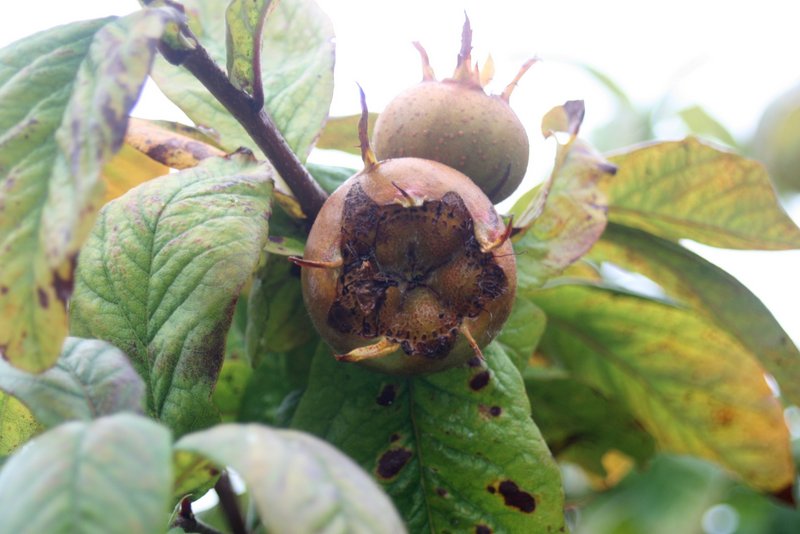
Varieties generally available are the Dutch ( largest fruit), Nottingham ( more upright), and the Royal ( better flavour). Also Breda Giant and Russian clones. We sell Nottingham. All are self-fertile.Named varieties can be grown on Pear, Quince or Hawthorn. They come from the Caucasus, so cold winters and hot dry summers are a clue to their requirements. The dry warm soils of Broughty Ferry is probably about right. Bob Flowerdew suggests only remedial pruning as they fruit on the ends of shoots.
The RHS suggest the following: ‘’pick when the stalk parts from the tree in late Autumn, and dip the ends in in strong salt solution to prevent rotting…..store with calyces downward, on slatted trays. Use when the flesh is brown and soft’’.
Ooh I almost forgot to mention, they have lovely autumn colour!
Refs:
Flowerdew, Bob, Complete Fruit Book, 1997, page 169.
RHS Encyclopaedia of Gardening, Ed. C. Brickell, 1992, page 387.
Tree Fruit Growing, Raymond Bush, 1962, pages 288-289.
http://en.wikipedia.org/wiki/Mespilus_germanica
Vines in Scotland
Can we grow vines in Scotland? The small village of Kippen in Stirlingshire ( blink and you’ll miss it ), was the site of a massive vine in the early twentieth century. It was however planted in a heated glasshouse, of the variety Gros Colman.
Almost on the beach in Fife, Christopher Trotter has a small acreage of vines planted , and after 5 yrs he is hoping to get a harvest next summer and produce the first grape wine in Scotland! The varieties he uses are Solaris Rondo and Siegerrebe, both from Northern Europe. It is a gamble to grow vines this far north, but he has chosen hardy varieties recommended by Vineyards in Yorkshire who have learnt a bit by trial and error. And he is in the warmest and sunniest part of Scotland, and who knows what climate change is going to do to us in the next few decades? It may become too dry to grow vines in the south of France one day. I spent last spring pruning organic vines in the south of France. It is amazing how they thrive in very poor stony soil and with no irrigation all summer. The local shepherd was allowed to pass through during the winter, so the ground gets a dose of organic fertiliser. Sulphur sprays were used to keep mildew at bay.
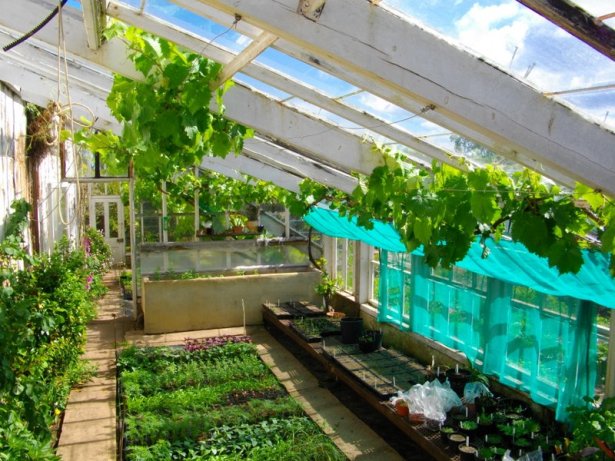
We have a Black Hamburgh grapevine in our glasshouse, and it never fails to give us a good sweet dessert crop as long as we keep the blackbird out when they are beginning to ripen! Somehow he always knows when they are nearly ready before us.It is important to keep the vines cool in winter, they dont like heat all year.
 plantsandapples.com