Food or First Aid? March 6th

A couple of uneventful days up till now. My wild salads consist of: ground elder, miners lettuce, rocket, hairy bittercress (not too bitter this time of year), fennel leaves from the greenhouse, lemon balm from a pot I have put above a radiator to produce rapid leaf growth, and Brooklime (Veronica beccabunga), an aquatic weed I have growing in a small pondlet which makes good watercress. A couple more days and shoots of Orpine (Sedum telephium) will be added. As there’s not much green, I have added chopped apple and beetroot – but down to my last half beetroot unfortunately.

Actually a bit worried about running out of stored and frozen veg before Easter. I remembered today (in the course of chasing the ducks off them) that I have some celeriac in the ground still- pretty minute but packs a lot of flavour. Spotted comfrey coming up today which is a great relief as it produces lots of leaf and is quite filling, but unless we get a week or so of warm sunny weather it won’t grow very quickly. Yesterday it snowed again, and the frosts are fearfully hard just now.

This morning I put some of my curd cheese in my omelette; thanks to the garlic and herbs it was most tasty (not exactly gourmet cheese mind). Hens churning out eggs well, ducks and goose show no signs of activity. They should remember I quite like roast duck. Anyway, whilst peeling celeriac for yet another stew (this one I nearly burnt and rescued by chucking in some fish stock I had in the freezer – tasted good!), I peeled deeply into the top of my thumb. It was excruciating and bled copiously. With a big pile of washing up to do and food to both find and prepare, it had to be stopped and from past experience I know the remedy. Yarrow.

Out to the nursery to see if any had come up yet – yes, it had! Then I remembered that yarrow tea is pretty acceptable compared with rosemary and wild strawberry – do I save it for tea, or stop the bleeding? (never mind the customers, their time will come). I chose healing. Made a poultice  by grinding the yarrow, applied it to the cut  and bound it with cotton wool and tape. Then donned a disposable glove to get everything done.

As is the way with yarrow, the pain stopped almost immediately, though the blood soaked the cotton wool. When I changed the dressing an hour later, the cut had very nearly sealed over.  It should by rights be throbbing, but hey, this is one old hippy remedy that WORKS. It’ll be fine tomorrow!

One Week on….. March 4th

Had a bad day yesterday – no matter what I ate it didn’t satisfy my cravings. I had a busy day at work, and by 11am despite a breakfast of mackerel fillet (the last – oh dear!) and poached egg, I could think of nothing but thickly buttered crusty bread. Lunch was at least as much as I normally have, of pheasant and spinach stew, and several equally bland herbal teas, but by 3pm there I was hungry again. A trip to Edinburgh to see the children and move a cat was made difficult by cold sleety rain, heavy traffic and Rowan not getting back till 5.40pm, by which time I was calling myself every name under the sun for being so stupid as to start this challenge, and wondering how on earth I could ever have imagined it was possible. Walking up and down the street passing food shops, an Indian takeaway and a fish and chip shop didn’t exactly help. I filched some rosemary from a tenement garden and when the daughter finally appeared made tea, with the rest of the stew and some scrambled eggs I’d taken down. I think I may be eating too many eggs, but still enjoying them!

But even then, on the long drive home I was feeling desperately unsatisfied and miserable. I couldn’t stand the thought of another 6 and a half weeks of this. Finally just before bed I had a teaspoon of donated honey…. and that did the trick. Carbohydrate craving – specifically, sugars. Ah well.

In general, I have survived OK so far, though I can’t say it has become enjoyable yet. Awareness raising maybe, but pretty boring. Today I have processed a load more apple rings, which are just so delicious, if chewy, and did something with the curd cheese. It smelt foul, tasted indifferent, so added plenty of garlic and herbs (dried from the garden last summer) with salt and pepper which I’m allowing myself. It might do for something! Possibly I am just not eating enough, possibly my stomach needs to shrink (few would argue with that!), and possibly when I really feel the need a spoonful of honey or sycamore syrup might be classed as medicinal? Adding my home-made chutneys and jellies to a meal might make them less bland as well. I am acutely aware how much I use food for comfort!

Taking ground elder now in tea – its not fantastic, on a par with cleavers and wild strawberry leaf. What I choose for a drink depends how far I want to go from the front door – if I’m still in my dressing gown its sage or strawberry.Last night I diluted some home-made raspberry and blackcurrant vinegar with hot water for a bed-time drink – a nice change.

Planning a many-egged Spanish omelette for tea, and about to go and forage for some salad greens to go with it.

March 1st

Severely put to the test last night. Friends of mine had a joint birthday party, with food. Johanna offered to cook for me one of the mackerel we had caught together in the Firth of Tay last summer, with veggies from their garden, and the event was to kick off at 7pm. That sounded great and didn’t break any rules! So I didn’t eat too much all day – just one of the potatoes I dug from James next door’s garden in return for the digging, for lunch about 1.30pm.

What I didn’t realise was that dinner was preceded by two hours of the most succulent and delicious-looking “canapes”  – which of course I couldn’t eat! I sipped at the home made elderflower wine I’d brought and realised I was getting light headed, and my stomach was making funny noises, so I went back to water. All the while this table full of food beside me…. anyway, I perked up considerably after wolfing down my mackerel, cauliflower and peas – and Johanna insisted on donating me the other 2 mackerel fillets they had defrosted, so I had one for breakfast. Had to disappear to the loo when the birthday cakes and the After Eights came out – more than the heart could bear.

Mercifully the hens have decided to start laying again, so I shall have some hard-boiled eggs to add to the slowly drying apple rings as snacks. I think I will just use the hazelnuts as snacks, too, rather than try to make them into a meal. Rose wanted rid of another cockerel yesterday who was brutalising her bantams, so I think I have no problem really with protein, and the hazelnuts are just a treat at times.

I had the cockerel hung up to pluck and draw this morning when I discovered the cupboard under the sink was full of water so was distracted by the need to do some filthy plumbing. By the time I had got that fixed, the cock in the freezer, tonights dinner (pheasant, leeks and a potato) in a slow cooker, and tomorrow’s vegetable stew for the food flask (I work a 12 hour shift on Mondays at the college), not to mention cleaning and drying the kitchen, it was late afternoon. So much for foraging! I’d have loved a pot of tea (how I LOVE tea), but had to settle for a wild strawberry leaf tisane, which is… acceptable.

I have my curd cheese hanging up in muslin to drain; and another pan of sycamore sap on the stove, and the house is tidy but I’ve had no time to relax this weekend. So pretty exhausted tonight, craving chocolate, or a mug of Horlicks, a biscuit…. I think I’d better go to bed.

Feb 25th-27th

Lent begins. On Shrove Tuesday, there was a pre-Lent good life banquet at the church, with everything donated and home grown, or wild. The main course was a wild deer – very fat he was too, and I brought back the fat for rendering, as well as the bones for stock. The fat was easily processed; it is very hard and white, and gives a good flavour in cooking. It solves, at least for now, the issue of whether I am allowed cooking oil during my Lent challenge. As for the bones, after boiling for stock I got four portions of meat from them.

Ash Wednesday, the hens having begun an untimely strike, I breakfasted on a fruit compote consisting of home grown raspberries, blackcurrants, strawberries, with brambles and elderberries from the freezer. I didn’t eat again till about four, then used a portion of the venison and some stock to make a sort of stew with a Jerusalem artichoke, a carrot and an onion from the garden, and some spinach. It did me for lunch on Thursday too. Later, I sorely missed my evening snack, but could only find a few hazelnuts I couldn’t really spare to scoff.

I am finding having to go in the garden to find an edible herb every time I want a hot drink a bit of a pain – especially as hardly anything is really growing yet – and also boring! Tried gorse flower tea on Thursday – tastes like hot water. Cleavers (known here delightfully as Sticky Willy) is about the best; sage is OK but not very flavoursome at this time of year. Passed a garden with a healthy clump of Sticky Willy growing in it. When the householder came out of his door, I only just avoided saying, “Scuse me mate, can I have a bit of your sticky willy?” This kind of thing can get you into trouble. As an alternative, I’ve spun the fruit compote into smoothies – astonishing number of pips! I am allowing myself home-made wine, but have been too wobbly so far to dare drink any.

By today, Friday, I need a rest from venison, good though it is. Hens deigned to lay some eggs, so omelette for breakfast (with half a leek) and a sort of Spanish omelette (the other half of the leek, carrot and defrosted runner beans) for dinner. With which I had roasted beetroot and artichoke with mixed herbs from the garden. Not too much wild stuff yet, but I did have a brilliant salad for lunch – miners lettuce, sorrel, garlic mustard, rocket, spinach leaves and the first ground elder, chopped finely with half a cooked beetroot and a chopped apple. Made a sort of dressing with Rose next door’s accidental cider vinegar that was meant to be apple wine and my redcurrant sauce. It offset the bitterness of the leaves and I really savoured every mouthful – something I’ve noticed that’s different in my eating experience!

Also I can feel myself becoming, of necessity, much more resourceful. As I write, the first bucket of sycamore sap is reducing gently on top of the stove. Collecting Sycamore Sap for SyrupA gallon of raw milk donated to the banquet that didn’t get used is curdling in the kitchen, hopefully to become curd cheese. Ian at the church gave me a bag of apples from storage from his orchard – as I am badly missing snacks, I intend to dry some as rings to carry to work with me. Traded one of Rose’s spare cockerels for some venison, and it’s stashed in the freezer. And I am noticing the emergence of every weed – today I saw the first shoots of Ramsons or wild garlic – and remembered I have some rather rubbishy cultivated garlic in the veg plot – suddenly reject vegetables and the tops of leeks become highly desirable!

As the warm weather continues, I hope to see an acceleration in the wild food options in my diet. I am hungry, and craving bread, oatcakes and biscuits especially. But so far, so good – even when I had to go to the pub quiz on Wednesday and drink a pint of water –  on the rocks.

February 15 – 17th.. tapping trees

We went to a brilliant conference in the Scottish Borders today organised by Reforesting Scotland, mostly about wild harvests from woodlands. Inspiring! especially the lady who lived for a year as they did in 18th century – makes my Lent challenge seem very easy and tame. A forester talked about some trials he’d done tapping trees for their sap – with some success, especially from Birch, Sycamore and Norway Maple. Boiling the sap down to make a syrup apparently takes time and fuel, but we could do it on the stove while it’s heating us. We have a sycamore just full of sap, and two birches, so we are going to give it a try – this could be my Lent carbohydrate source!

In the afternoon, we got to innoculate two birch logs with fungal spawn in sawdust and bring them home. We did one of Oyster Mushrooms and one of Shiitake, and are prepared to be patient – it was two years before my last oyster log fruited – and turned out to be shiitake anyway! So long as we don’t forget what the logs are and put them in the stove…

The snow has melted and temperatures have risen. It was good to see under the snow young shoots of Cleavers (or Goosegrass), which are edible and make a nice drink, no doubt I’ll be glad of that next week. I’ve had no caffeine now for 36 hours and the headaches are gone….. would still love a cuppa tea though…

Roadkill potatoes fallingoff the back of an overloaded trailer today…..

September and October Catch-up

September passed in a bit of a blur, to begin with – as always the start of this month dominated by the Dundee Flower Show and its pre-math and aftermath, coupled with the start of a new term at the college, which was more complicated than usual!

So what follows is by way of a summary for a month that is actually a good one for foragers usually – just needed a bit more time in our case.

On 10th, I foraged along Crieff Road in Perth for fruits and nuts for purely educational reasons, but noted some excellent elderberries on campus, and some tedious municipal planting yielded a nice bag of Japonica quinces (Chaenomeles japonica). These fragrant fruits (they are pomes to be exact) make a lovely addition to fruit pies and puddings. Blackberries ripe trailing over our back wall from the neighbours – started to harvest and freeze them.
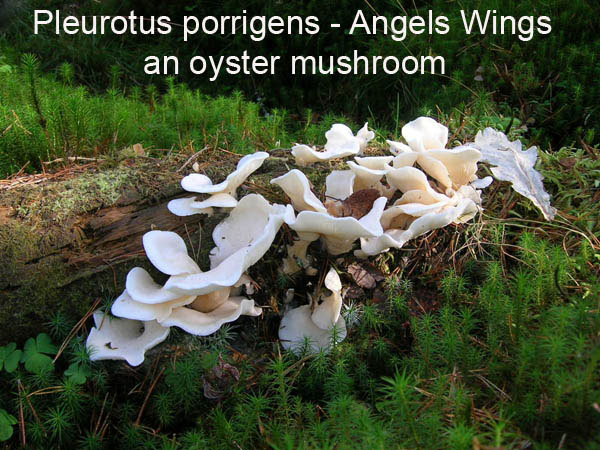
angels20wings20web


On 14th, we went fungi-foraging and netted some Slippery Jacks, one Cep, Bay Boletes and several Angel’s Wings. Angel’s Wings are Pleurotellus porrigens, related to Oyster Mushroom but subject to some doubt in internet circles as a couple of folk in Japan once were ill on them. We’ve eaten them regularly for quite a while, and so have many others, so I am suspicious about the identification in the case in question. Worth bearing in mind, though that people can react differently to individual species, hence the confusion when one book says “edible” and another says “best avoided” or similar ambiguous verbage. The other find on the 14th comes into this category – Plums and Custard (Tricholomopsis rutilans). It’s easy to identify because Plums and Custard perfectly describes the colouring, so is good to eat on that score. Can be slightly bitter, but we eat it anyway. Braised it with shoulder of lamb and cranberries from our garden.


On 19th, it was rowan berries day. Collected a big heap of them and made rowan jelly – delicious. That week, the boletus and chanterelles I dried in July and August were put into jars for winter use, and noted the rose hips were looking good. Shaggy Ink Caps were spotted at the college, but turned to ink before I could pick them. On 26th, we raided one of our usual haunts and found, apart from the usual fungal suspects which we rounded up, a new one – Hydnum (or Sarcodon) imbricatum – a type of Hedgehog Fungus. They were tea-plate sized, scaley fruiting bodies by the edge of the path, quite spectacular. As we had never seen it before we only took one for identification, and I’m glad because they are apparently quite rare, pinewoods in Scotland being the preferred habitat. Edible though – and delicious!

Puffballs were taken with roast beef on 28th, and a dessert of blaeberries, brambles and cranberries completed Sunday Dinner.

October

Now I look at it, October is also at an end!

On 4th, we harvested a large crop of wild hazelnuts from the plantation, and so did our friends. There were plenty left for the two wild food workshops we held this month, but I seriously think it is time to coppice the hazels – the nuts are getting too high to reach! We gathered rosehips too and made syrup, and brambles continued to provide sustenance and desserts.

Removed a large Sweet Cicely that had seeded itself in the wrong place in the garden, and turned the large fat roots into soup, along with other vegetables. The aniseedy flavour when cooked is mild and enticing, blending well with other tastes.

The two workshops found plenty overall to forage, but fungi were not so thick on the ground as we might have hoped – a cold dry snap had temporarily put a halt to fruiting. Nevertheless, one high point was a massive fruiting body of Grifola frondosa which our neighbour Geoff served as a starter on the evening of the first workshop. Andrew and I squabbled over identification, I thought it was Cauliflower Fungus (Sparassis crispa) to start with, but we all realised it was just too “chunky”. Next week we found Cauliflower Fungus as well and were able to compare them side by side. Geoff found a very young Beefsteak fungus (Fistulina hepatica) – this is significant because it didn’t have any maggots in and we all got a small mouthful. Yum. A range of other edible fungi have been eaten – some good – no excellent – crops of Honey Fungus in the Forest Enterprise wood, plenty of Lycoperdon perlatum puffballs and when all else fails, Common Yellow Russula. (All else did fail, for a brief spell last week and I bought some chestnut mushrooms, reduced. Then honey fungus appeared on the lawn). We normally get a reliable crop of Shaggy Ink Caps in the hen run, but not this year, I suspect the ducks of eating them.


Nut front – Bankfoot chestnuts produced niggardly little nuts, no use to man nor beast, but James next door brought back some fat Surrey ones from Bisley, which we are roasting on the stove merrily, with the hazelnuts. Andrew went on a cider making course and has been scrumping furiously the apple crop of our other neighbours (with permission!), along with any others he can find. I went to Northumberland and found a great apple tree right in the middle of the sand-dunes at Bamburgh. We have got out our old cheese press and are also producing fresh apple juice, which is astonishingly good. Pete, who came on the second workshop sent us a tiny, but perfectly formed, pear to identify that he had found while scrumping. We were stumped, but Andy my colleague at college identified it as the Plymouth Pear, Pyrus cordata.plums20and20custard20web
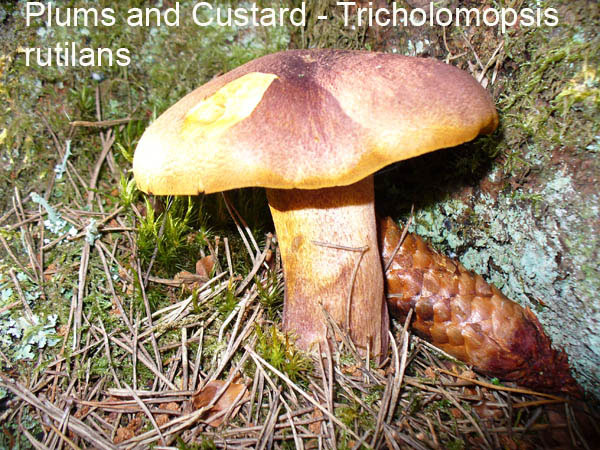
On 19th, I gathered elderberries and made a gallon of wine, and froze two boxes of them. Fished some out last week and made Elderberry Muffins. More Plums and Custard found on 26th.

Wild weather has seen off the rest of October – firstly howling gales and cascades of rain, then snow, followed by a big freeze. Time to stay by the stove and roast chestnuts!

August 2008

August – Weeks 1, 2 and 3.

More chanterelles, more wild cherries. We think it’s odd that the several fairly old cherries in a hedge line from which we gather the fruits all seem to produce fruits of varying sweetness and colour when ripe. One is almost black, another, barely red. All delicious, though. Any theories, anyone?

One long walk on 10th produced in addition to a sack of chanterelles, Plums -and-Custard mushrooms (Tricholomopsis), Birch Boletes and larch Boletes, and tawny grisettes. The chanterelles from this trip we dried, by threading them onto cotton and hanging them as garlands in our warm shed. When they are nearly dry I will de-thread them and spread them on trays over the boiler to finish before putting them in tightly sealed jars for the winter.

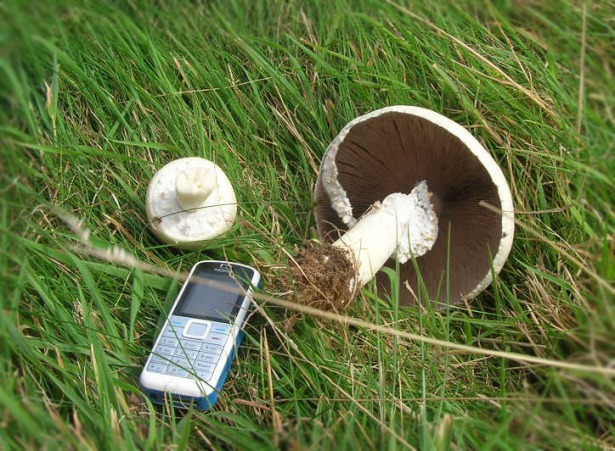
On the 11th, I macro-foraged! In that I went sea angling from Arbroath with friends, and caught 7 big mackerel. I hadn’t been before and must admit the sea was choppy and a tad nauseous, but I got over it and would definately like to go again. As my friends were going on holiday the day after, I managed to “forage” (borrow? steal?) 5 of their fishies too to make a round dozen which I have cleaned, filleted and frozen, or eaten. The same day, Andrew brought home a bag of field mushrooms he’d found at work, which I turned into a delicious soup.

Then we went on a week’s holiday to Norfolk, and got to try out some wild foods on Andrew’s unsuspecting (or suspecting?) family. At Holkham Beach we gathered samphire, oh how I love samphire and it especially nice after being exiled from this East Anglian delicacy for a couple of decades. Steamed for 15 minutes and tossed in butter, this unprepossessing-looking product of mudflats with its fleshy, salty stems is incomparable. We didn’t gather any more, no-one seemed that enthused except us, but perhaps we shouldn’t have inflicted the seaweed Sea Lettuce on them in the same meal. Filamentous pale green sheets you’d think wouldn’t take much to cook, but in fact it was a bit chewy. Next time I would make more of a meal of it, with some flavouring, longer cooking, combined with mushrooms perhaps…. not really a side vegetable with roast pork. The apple sauce, though, was made with a combination of wilding apples from the hedgerow, “scrumped” eaters from an abandoned garden, and wild water mint, and it went very nicely. Likewise, we all enjoyed (I think that’s the word) the mind-banditing sharpness of Sea Buckthorn berries growing on the dunes near Old Hunstanton, and Andrew brought the pips home in a hankie…..

We kept a supply of fungi going through the week – puffballs, horse mushrooms, grisettes etc. – some of which were appreciated, the rest we just ate ourselves.

Horse Mushroom

Horse Mushroom

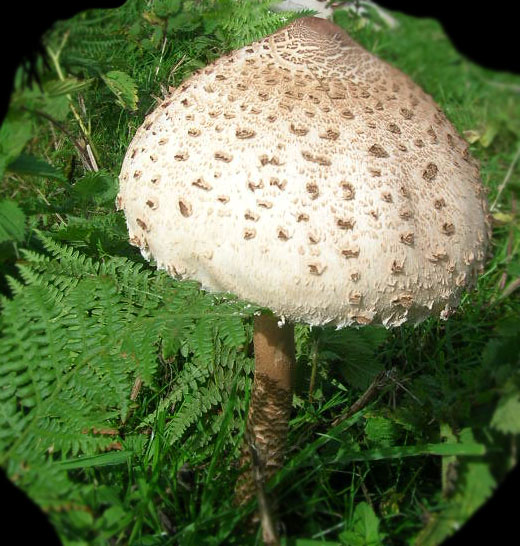
I was specially excited by the Roman mushrooms – found while exploring the site of a Roman fort at Brancaster. Resisted some big Parasol Mushrooms (Lepiota procera) at Wretham Heath – after all it was a nature reserve – look forward to finding some more before the summer’s out.

Parasol Mushroom

Parasol Mushroom

Back home, we realised the fridge was empty so went out after more chanterelles and found, in addition, an absolute HORDE of Boletus edulis, the Cep or King Bolete. However, most of them were coated in white and contorted or deformed in a most sinister looking way. We think – but please educate us if you know better – these specimens had been affected by the torrential rain which had obviously been plaguing Perthshire in our absence and fallen foul of some predatory fungus themselves. Luckily there were some good specimens, as well as a variety of other boletes and the first Slippery Jacks. We have cleaned, sliced and set these to dry for winter, but the Ceps are for tea tonight. While out we snacked on some lovely little wild gooseberries, and checked the progress of rowan berries in general.

July – last weeks

July – Week Four
Ah, now we’re talking. This weekend, Andrew and I, having spotted some growing by the A9, went cycling after Red Elderberries. These are the fruit of Sambucus racemosa, a non-native but commonly naturalised sister of the familiar Elder (Sambucus nigra). They ripen earlier than the native berries and don’t taste quite as good, but can be used for the same things. Being in the midst of a glut of soft fruit, we wanted to pick some to mix 50-50 with blackcurrants for a red wine. After picking them we thought, it having rained copiously last week (especially on Mull of course), that we should just check for fungi….. and YES!! the first Chanterelles, and a couple of Brown Birch Boletus, and a few fairly chewed Russula lutea. These all went into a delicious pie for dinner. Pointed out we still have last years dried chanterelles to use up. On the way back we picked wild cherries and wild raspberries (inexplicable as the garden ones are coming out of our ears at home but we couldn’t resist….. we ate them as a TV snack to accompany Midsomer Murders (well, you need something..)

Today I sampled the pickled ash keys I prepared in March – and they were good! I seem to have perfected the timing and recipe (well it was John Evelyn’s recipe to the letter actually).

July – Week Five
We’ve both had a week more or less off work this week – though spent much time in the garden.

We decided it was time to see what was happening in a local Forestry Commission wood which gets a good range of autumn fungi normally…. I wanted Tawny Grisettes especially, and there were quite a few. This is an un-nerving fungus for the beginner, being in the same family as Death Cap and Destroying Angel (Amanita). But once you know it, you can’t mistake it for anything else, even from a distance. It stands on a tall stem, no ring around it unlike the death cap, and the reddish-brown cap, conical at first but soon flat, is edged with little striations. Slugs love them (regrettably) and so do I. We also found a single Bay Boletus (Boletus badius), and a relative we hadn’t tried before – Suillus variegatus. This was nice, though not over-tasty. There were quite a few edible Russula atropurpurea, but the slugs had largely had them already! But there were MOUNTAINS of chanterelles….. kept us going for days…..

Dimly aware the English school holidays were starting, we also gathered several pounds of blaeberries (bilberries) by the River Braan. The connection here is that the English hols is when we are most likely to meet up with Tim and Gill and their daughters. Tim is a compulsive and exhausting forager even by our standards, and we have fond, gooey memories of Tim’s blaeberry muffins! Anyway, as usual we spent ages filling a bag with small, sparse and hard to find berries on ankle-high plants, only to get round the corner and find big juicy ones a dozen to a stem on nice tall bushes, which took no time at all to pick. The moral is never start picking till you’ve found worthwhile quantities! The blaeberry is good wayside snacking; they have kept us going all week on walks and cycle rides, here and up at Braemar where we went camping.

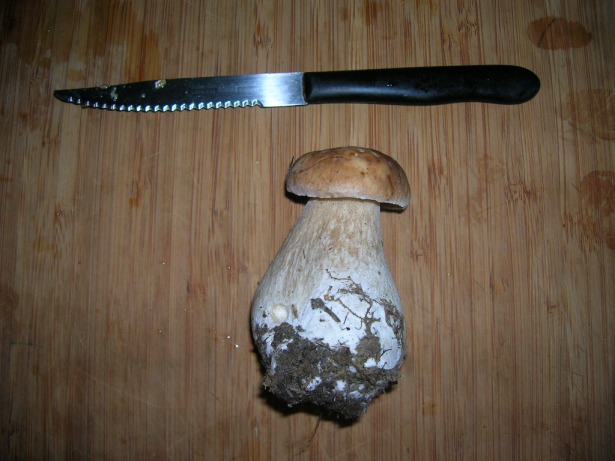
Cep (Boletus edulis)

Cep (Boletus edulis)

On Monday, Andrew spotted a perfect, un-maggoty, classic Cep (Boletus edulis). They’re called King Boletes on the continent, and they taste magnificent. This one did both of us for breakfast. To finish the week, I’ve just come back from a bike ride. I had no intention of foraging so didn’t take a bag. Instead I ate all the big juicy wild cherries there and then (pig). But when I saw the chanterelles in the wood…. well, did you know you can stuff the sleeves of a cardigan full of fungi, tie it round your waist and get them home in perfect condition? Good timing, I was seriously thinking of buying some mushrooms.

July – Third Week

July – Third Week
Rowan and I were camping on Mull this week, at Fionnphort in the far south west of the island, right by the beach. We stopped at a wood on the way over to Oban for a picnic, and had a walk. “Bet I can find something to eat” I said, and lo, there were hordes of delicious blaeberries (bilberries) just asking to be picked. A German couple were already tucking in so we wasted no time in collecting a bag each to serve as snacks for our camping trip. We finished them the first night though – Rowan turned purple. “You can never have too much fruit Mum,” she frowned as I suggested she might want to slow down. Later in the week she repeated it as she foraged a hedge in Salen for wild raspberries. Also in the little wood I found some Orange Peel Fungus on the path – a flavourless but attractive ascomycete we saved for breakfast.

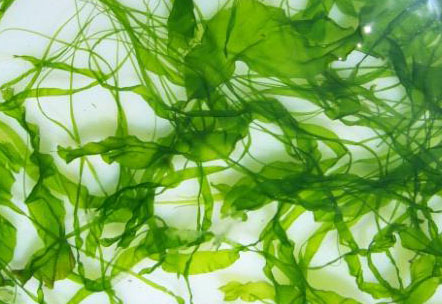
ENTEROMORPHA INTESTINALIS
Being by the beach, seaweed had to be on the menu. Enteromorpha is bright green, roughly cylindrical and looks like a pile of translucent, irridescent guts where it grows in profusion in rock pools and shallow sea. But don’t be put off – we had it stir-fried in butter with a single field mushroom we found in the hills and it was delicious.

Enteromorpha - an edible seaweed

Enteromorpha - an edible seaweed

I threw in some Serrated Wrack (Fucus ?) as well, but the meths ran out in the trangia and I think it could have done with longer cooking.

On Iona, we found some wonderful flowers on the machair, but the only wild food was Crowberry, with black berries, and I couldn’t remember if they were edible so we didn’t. Apparently, they are – this month I seem to be getting to grips with all these odd “something-berry” plants.

July 2008 – Week 2

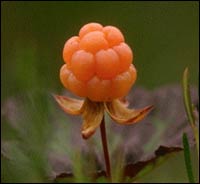
Andrew brought down from the Cairngorms some fruits of Cloudberry (Rubus chamaemorus), which we hadn’t seen before let alone tasted. They grow up in the boggy bits of mountains. They tasted a bit watery, but perhaps they weren’t really ripe.

Another month or two, they would have been soft and apparently juicy – at this stage they can be used in jams, puddings and crumbles. Maybe another time!

Cloudberry