Farm Shops of Scotland

Intensive Apple Orchard at Craigie Farm

Intensive Apple Orchard at Craigie Farm

I love the fact that you can enjoy a cup of good coffee, buy a delicious local artisan oatcake or black pudding, and pick a few fruits for your pudding in one short trip. These are things you cannot do in style in the crowds and hassle of a supermarket.

My most recent trip was to Craigie Farm Shop near Kirkliston, a pyo farm, much of which was open to the public.On a Sunday afternoon it was very busy, but there are lots of seating in and outside the cafe, and I like the idea of the canine cafe! However poor Jed was banned from the fruit growing areas, the impressive polytunnels with table tops groaning with strawberries and pots of raspberries.

After viewing the grunting pigs, and the friendly Shelties, we followed the nature trail along the lines of open grown heavily laden gooseberries, and surprise surprise came upon a fabulous modern orchard. (There’s always an ulterior motive with Appletreeman! )

I have seen this square block of trees developing over the last year from the dual carriageway into Edinburgh, and was determined to check it out. It is as I thought, a very exciting new development in top fruit growing in Scotland. There are about 15 lines of very closely spaced trees, at one meter, on very dwarfing stocks of M9. It all looks very well managed, and very productive with sunset, worcesters, katy etc. all yielding fruit in this rather mixed year.

Very good to see that lines of Italian Alder have been planted as shelter belts also, a necessity for this easterly plot way down the bank, whereas some cherries further up near the cafe seem to be more exposed. Back at the shop we picked up a few punnets of fabulous rasps and gooseberries and set off home very pleased!

The farm is not organic, but allows the public to see into the tunnels so common in Perthshire, with real commercial horticulture in action, weeds and all! We will certainly be back, hopefully at a less busy time to speak to the ‘patron’ and of course for the harvest of apples!

Apple Scab Control

The Control of Apple and Pear scab by Sulphur Sprays

My James Grieve has for the past 3 years suffered some scab on the leaves. This wouldn’t be a problem, except for the fact that it can severely mark the fruit in due course and in wet seasons. By resorting to a regular spray of sulphur, I have managed to prevent it reaching and marking the fruit. Sulphur is a basic chemical, so relatively harmless to the environment. The weather conditions earlier this year in the east were very favourable for scab spores, but luckily this last week’s dryer conditions has improved the situation tremendously. In the west of Scotland it is a problem most years. Powdery mildew has also been prevalent on many apples this year also and sulphur will reduce this also. It attacks the new young leaves and slows down the growth of trees for many months.

I use 5.6 mls in 10 litres of litres water and spray the leaves every 10 to 14 days if I can. I start at the ‘pink bud’ stage and continue until the end of extension growth, around about mid- July. It is essential to achieve good coverage of all parts of the tree, especially the growing points – they will have the appearance of a smattering of snow after spraying!

Certain varieties of fruit trees and bushes may be damaged by sulphur sprays. In the old books they called this ‘sulphur shyness’. The following are reportedly susceptible to leaf damage: Beauty of Bath, Belle de Boskoop, Cox’s Orange Pippin, Lane’s Prince Albert, Lord Derby, Newton Wonder, Rival, Stirling Castle, and Doyenne du Comice.

My Hawthornden seems a touch damaged, and possibly my George Cave, but since the first few applications, I have restricted my sprays to Worcester Pearmain and James Grieve only, the only two in my garden showing any significant scab symptoms.The Boskoop seems to be ok in my garden, and none of the pears show any damage.

I have seen scab on Scrumptious this week, and many new so-called resistant varieties usually succomb after a few years in the field unfortunately. Knowing when spores are in the air is how the professional’s are able to time their spraying; we may rely on regular pruning and good open sunny sites as the best prevention!


Hop production in Scotland

Hop Production in Scotland

For the beer making fraternity the subject of hops and the merits of its various clones are of great importance. To gardeners, more bent towards ornamental plants, the growing practicalities of this climber under Scottish conditions are of more interest.

What is it? Humulus lupulus is a climber related to cannabis, and has twining stems and tiny little hooks to enable it to grip onto to any upright object it can find.  It’s surprising how tough these stems are in mid season, I’m sure John Seymour would have recommended basket weaving with them!

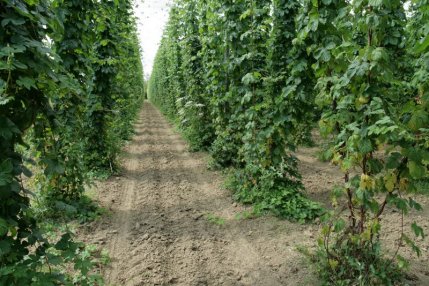
It is a perennial, and would normally die back late in the year and send out new sprouts from a permanent root system every spring. It is a plant with purpose in several ways…the young emerging shoots can be eaten like asparagus. Professionally, four shoots are allowed to twine up from the clump of roots on 4 spaced coir strings to over 6 metres, creating a veritable vertical forest of growth by high summer.


Hop weed control

Well cultivated ground between rows of Hops.

I have seen an organic hop farm in Kent, where the plants are grown on a little ‘hillock’ and carefully weeded by rotavator between all the plants. The height and width of a hop wiring structure is a truly impressive structure to see!  I have also seen hop farms in Worcestershire, again on very good soil.  Overall though, the acreage is a lot smaller in the UK than even decades ago. A good deep fertile soil is ideal, perhaps the Tay Valley is the place for a Scottish Crop? Wye college in Kent developed some dwarf varieties, so the risk of wind damage might be reduced.

In late June, on the female plants, side shoots develop from the main stems and subsequently these produce the flowers which are so prized ornamentally. You don’t want male plants or you will get seeds which are undesirable!  Later the flowers form the ‘hops’ and all the stems are cut down to be taken indoors for extraction. The oast houses of Kent were once the drying rooms for the hop industry.

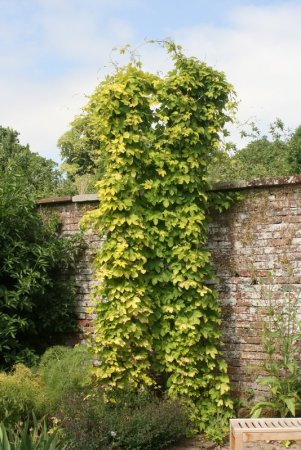
The hop damson aphid can be a big menace, and I’ve seen mildew on the leaves on our plant in wet summers.  Apart from that we have few problems and every year our golden-leaved hop scrambles up against a sheltered shed wall and produces little hops for us.

Propagation can be by division of the whole clump of roots, or fertile seeds can be purchased if you want to have a go of growing your own. To get a particular variety of course you would need cuttings or divisions, or layer a shoot across the ground and slightly bury it to encourage rooting. There are some lovely named clones such as White Knight, Fuggles, Goldings;  the RHS Plantfinder lists about 14 different sorts (page 365 ).


Hops - golden

The golden leaved hop, Humulus lupulus ‘Aureus’.

Seed grown plants can be supplied from plantswithpurpose, so what’s stopping you covering that horrible shed?

Ref: The RHS Plant Finder 2004-5, pub. By Dorling  Kindersley.

Spindlebush Apple Trees

The Spindlebush Method of Growing Apple Trees

Some of the small apple and plum trees i left in the field after i moved my nursery two years ago ( I move to a new patch every year), started to fruit this year in earnest. At the moment they have central leaders and i have the option of letting them branch out with 5 or 6 framework branches, and later cut out the leader to form open centred trees. This is an easy method of formative shaping to understand for amateurs and semi-professionals.

However, with the advent of dwarfing rootstocks, in the early 1940’s in Germany, and later in Holland, the growing of high density spindlebushes was becoming of great interest to growers. We in the uk were still growing very large trees on M7 rootstocks at a very wide spacing, and it was only post – war visits to Germany which opened our eyes to developments there.

So here are a few jottings on the subject:

So what are spindlebushes?

Its similar to my cordon grown trees, in that it is all about having fruiting wood in abundance and basically nothing else! Those of you who have attended my workshops will be familiar with the need to identify fruiting wood.


Its advantages are as follows:

Very high rates of production per hectare.

Small trees, enabling pruning, spraying and harvesting from the ground.

Very efficient use of land and available sunshine.


They are normally grown on very good land, and M9 rootstocks, a very dwarfing one. Basically, there is a central stem and lots of wee laterals to carry the fruiting buds. A tall thin pyramid is required. Thicker pencil sized laterals are cut back to 4 buds, anything thinner to 2 or 3 buds. Cut to downward facing buds always. So horizontal wood is the aim, use spacers if necessary. Unlike some methods I teach, this one requires very severe pruning. The leader is pruned – that is the new growth to 4 or 2 buds on a weak tree.

The common mistakes are to not cutting back the leader hard enough and allowing too much fruit early on leading to stunting of shoots. The aim is to have lateral branches with lots of fruiting spurs and no gaps along the branches.

Red George Cave

Fruit from my 2 year spindlebush tree

In late July, the new growth from the stubs are tied down to form horizontal fruit wood. Be careful not to droop the ends below horizontal if possible. Prune back all sub-laterals in summer

(‘Lorette pruning’), or next winter if you forget! You can allow your laterals to branch to fill the space a little, such as if theres a gap in your tree you want to fill. Tie a higher one down to fill a space if necessary. Keep the pyramidal shape by pruning harder if necessary your top laterals. Each tree should yield 10 lbs of fruit by the 4th year. The original spacing recommended was 10 feet ( 3m) and 435 trees per acre. In you have an acre, you could be producing 4.3 tonnes of fruit by your 4th year! Using an m26 rootstock in most areas of Scotland, and tieing to stakes or wires in North-South lines is probably ideal. A modification is the Tall Spindle, which is allowed to grow to 3m and planted 1m x 3m spacings. It must have up to 10 short feathers ( branches) already from the nursery. Visit your nurseryman and select your trees personally!

If you want to know more about pruning workshops, please see our google calendar on the website http://www.plantsandapples.co.uk.


References:

Wertheim, S.J., The Training of the Slender Spindle of Four Apple Varieties. Nov. 1970

Golschmidt and Delap, The Spindle Bush Method of Growing Apple and Pear Trees, The RHS Fruit Yearbook, 1950, pages 54-66.

The RHS Encyclopaedia of Gardening , ed C. Brickell, page 380.,1992.

http://fruitgrowersnews.com/index.php/magazine/article/The-Tall-Spindle-System-Apple-Orchard-Design-For-The-Future

Fruit trees and Frost

Frost protection of Fruit

All gardeners are aware of the dangers of frost on young opening leaves and flowers of many types of fruit in spring. An orchard owner in the Clyde valley told me the story of how his father used to light barrels of oil under his plum trees on frosty nights! And in the late 50’s wind pumps and heaters were being used in some countries. The 2012/13 winter in Scotland was very prolonged, but it turned out to be very beneficial.The apple blossom was almost a month later than usual, missing damaging frosts, and many varieties flowered at the same time. The effective pollination period was thus very short but very effective! The harvest of 2013 was superb! its the more usual erratic springs which cause us the problems.

Our main worry is the early frosts catching Oslins and Scots Dumplings, and the late frosts in mid-May which can destroy the later flowering Worcester and Cambusnethan trees chance of fruit.


How do professionals overcome this?

1-The best answer of course is not to plant your trees in risky areas such as frost hollows or the bottom of slopes.

2-Secondly, choose known hardy varieties for your area, i.e. not fruit that is grown widely in the warmest areas of France or the South of England. Hardy varieties have been bred and are grown in places like Poland, Norway and Canada, and some well known British varieties are very hardy: Keswick Codlin, Golden Spire, Emneth Early for example. We are actively propagating a few very hardy Swedish and Norwegian summer apples…so look out for them in our catalogue.

3-Thirdly, you may try to cover your trees on frosty nights with fleece or blankets. I tried this one winter, but realised that a lot of buds get damaged in the process of constant removal – you have to let pollinating insects in to do their work every day!


hanginggardens1

Some experiments in the 1950’s proved that covering is ineffective by and large. They tried using an electric heater and running a hose every 15 minutes over the branches. By far the most effective treatment was to provide a fine mist spray over the flowers as the temperatures dropped.  In essence, the water prevents the temperature of the flowers going below freezing by latent heat of evaporation.

These spraying experiments, by JH Jeffree ( RHS, 1950), resulted in achieving a good crop on adjacent sides of two apple trees that were receiving spray. The far sides of each were bare of fruit come the summer! The effectiveness of, and the spray coverage, was improved by using a rotating spray head on a long pole.

If you want to try this next spring, be aware that a lot of ice can form on the twigs and branches so watch they don’t break under the weight! A few props for the weaker branches may help. You may need to be doing a few night shifts from early April to mid May this year!


References

Jeffree,J.H., 1950, RHS FRuit Yearbook, 1950.pages 100 -104.

Some notes can also be found on : http://hos.ufl.edu/extension/stonefruit/frost-protection-orchards-0 and http://ucce.ucdavis.edu/files/repositoryfiles/ca1208p4-64660.pdf and also:

http://fruitgrowersnews.com/index.php/magazine/article/protecting-your-fruit-from-frost-and-freeze

Apple Trees and Flooding

Many of you will be planting new fruit trees this spring and will be wondering what effect all the rain will have on your trees. At present your trees are dormant and most likely you are planting them as ‘bare root’. It is well known that up to 90% of your trees roots may be killed when they are lifted out of the nursery and replanted, so it is very important you keep the roots moist and frost free to preserve what’s alive.

Tree roots need oxygen, and prolonged wet conditons will create anaerobic conditions and many more roots will suffocate. In spring, your trees will have a hard job growing new roots and getting the nutrients necessary to grow, flower and fruit.

Another worry is a fungus disease called Phytophora or collar rot which can attack your trees in the summer after a very wet winter.  So don’t exacerbate this situation avoid those wet hollows in your garden, don’t pile masses of compost around the roots,  and look forward to a nice dry spring and summer!

Also many beautiful productive fruit trees can blow over due to wet soil, so see to your drainage!

Windblown Tree

Medlars

Medlars are rather plain looking trees – admittedly they are rosaceae, but the flowers are just white amongst many other better rosaceae, so why are they of interest? They have been cultivated for thousands of years, and its very likely the Romans brought them here.
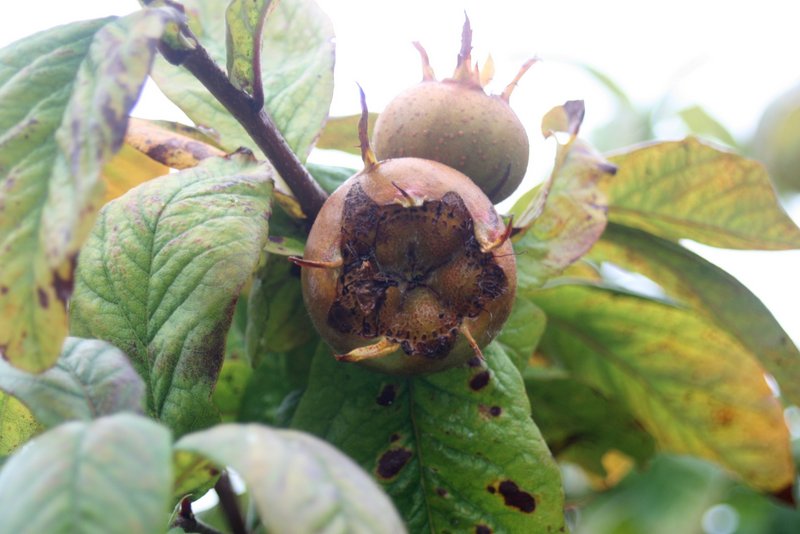
Well its the fruit, which is not quite like anything else! They are actually pomes, and are brown, earthy tasting and either hard or soft and almost rotten! They are about 5cm across and brown.We tried some at The Harmony garden at Melrose once, and they were definitely an acquired taste. They are in fact a useful late fruit as they aren’t ready until mid- winter.
So what are they used for. Traditionally they need to be ‘bletted’ i.e. until the frost has softened them. Some suggest this isn’t actually necessary.However, the best use of them is to make into jam or jelly.
They will grow almost anywhere, I have seen them at Kellie Castle in the lawn, and in a hedgerow at Broughty Ferry. Remembering where they are and getting the fruit is important if they’re in a hedgerow.

Medlars

Varieties generally available are the Dutch ( largest fruit), Nottingham ( more upright), and the Royal ( better flavour). Also Breda Giant and Russian clones. We sell Nottingham. All are self-fertile.Named varieties can be grown on Pear, Quince or Hawthorn. They come from the Caucasus, so cold winters and hot dry summers are a clue to their requirements. The dry warm soils of Broughty Ferry is probably about right. Bob Flowerdew suggests only remedial pruning as they fruit on the ends of shoots.

The RHS suggest the following: ‘’pick when the stalk parts from the tree in late Autumn, and dip the ends in in strong salt solution to prevent rotting…..store with calyces downward, on slatted trays. Use when the flesh is brown and soft’’.

Ooh I almost forgot to mention, they have lovely autumn colour!

Refs:
Flowerdew, Bob, Complete Fruit Book, 1997, page 169.
RHS Encyclopaedia of Gardening, Ed. C. Brickell, 1992, page 387.
Tree Fruit Growing, Raymond Bush, 1962, pages 288-289.
http://en.wikipedia.org/wiki/Mespilus_germanica

Vines in Scotland

Can we grow vines in Scotland?  The small village of Kippen in Stirlingshire ( blink and you’ll miss it ), was the site of a massive vine in the early twentieth century. It was however planted in a heated glasshouse, of the variety Gros Colman.

Almost on the beach in Fife, Christopher Trotter has a small acreage of vines planted , and after 5 yrs he is hoping to get a harvest next summer and produce the first grape wine in Scotland! The varieties he uses are Solaris Rondo and Siegerrebe, both from Northern Europe. It is a gamble to grow vines this far north, but he has chosen hardy varieties recommended by Vineyards in Yorkshire who have learnt a bit by trial and error. And he is in the warmest and sunniest part of Scotland, and who knows what climate change is going to do to us in the next few decades? It may become too dry to grow vines in the south of France one day. I spent last spring pruning organic vines in the south of France. It is amazing how they thrive in very poor stony soil and with no irrigation all summer. The local shepherd was allowed to pass through during the winter, so the ground gets a dose of organic fertiliser. Sulphur sprays were used to keep mildew at bay.


Grape Vine

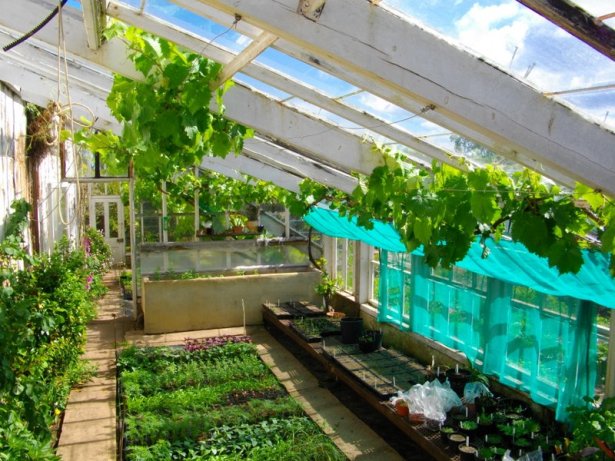
We have a Black Hamburgh grapevine in our glasshouse, and it never fails to give us a good sweet dessert crop as long as we keep the blackbird out when they are beginning to ripen! Somehow he always knows when they are nearly ready before us.It is important to keep the vines cool in winter, they dont like heat all year.

In a Nutshell

In a Nutshell… Set to and brutt your plats!
Some notes on Hazelnuts in Scotland.

The hazel is an important native tree to Scotland (they floated in to the west coast perhaps), and as we sell cobnuts and hazels at Appletreeman, I thought I would put down some notes on their cultivation. Unfortunately there is no information on how to grow them for profit in Scotland, and as most of the UK production is in Kent, and places like Piedmont in Western Italy and Turkey have a thriving hazelnut industry, I have had to glean some notes from old books and European papers. So let’s start with what we do know about their cultivation from these other areas…

We have a Hazel plantation near us, which is productive most years from trees closely spaced and about 25ft tall. They are very vigorous, having lots of ‘’water shoots’’ extending up through their centres to reach the light. The fruit is almost impossible to harvest… we have to wait for them to drop after the Squirrels have had their fill! If we are lucky, there may be piles of nuts surviving under the winter’s blanket of snow. The trees are 14 years old and almost perfect for coppicing now and making use of the rods for hurdle making etc. However they aren’t so good for nut production and collecting.
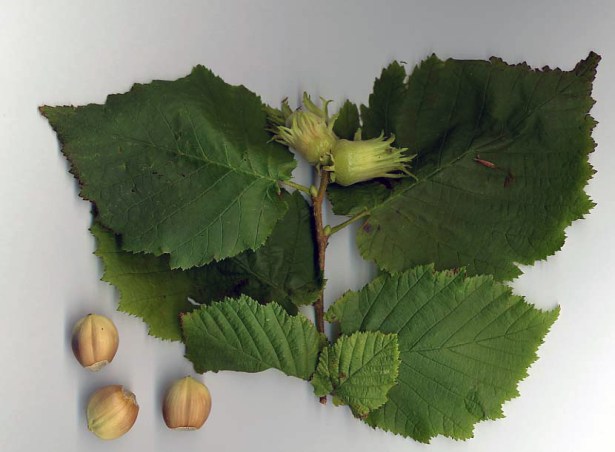
Corylus_avellana

Our native hazel is Corylus avellana. The filbert with its ‘’bearded’’ cover is C. maxima. W.J. Bean lists 10 species, Hillier’s Manual, 8 species. The 2004/5 RHS Plantfinder has 53 entries of species and varieties.They are all native to Northern climes. It is suggested by Bob Flowerdew that these two and C. americana and C. colurna have all interbred to some extent and account for our productive nut clones of today. (see refs. below).

The problem with our local C. avellana for production of nuts is partly due to them being on the very good glacial soils of Tayside, making very vigorous trees, and their close planting drawing them up to the light. So, don’t be too worried about planting on a stony or less favourable soil, though probably avoid wet areas and frost hollows. And don’t crowd them in. A nice well-drained slope with some protection from the East is probably ideal. And they quite like an alkaline soil, though this isn’t essential.

Our local hazels flower very early, sometimes February, usually March. The male catkins are forming, and extending from November, the little red females later. They are wind pollinated, so shaking the branches, or even performing pollination with a little brush on a nice early spring morning is ideal. Of course, you would need reachable branches to do this. Hopefully the male and female flowers will be open at the same time. Our native Hazel must undoubtedly be very hardy, though the non-cropping years are probably due to frost damage. I wonder if we should be investigating late flowering varieties here in Scotland? (See lists below from various authors).
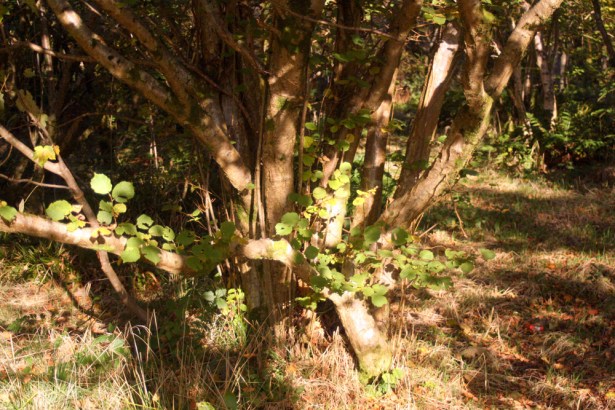
Hazels to coppice at Duchess Woods

Hazels to coppice at Duchess Woods

When you receive a new tree, aim to have a short stem and 5 or 6 branches only. Tie these down or put spacers in to make these fairly horizontal – i.e. make a goblet shape. Any shoots coming up through the centre should be ripped off, and suckers removed also. This may be a continuous exercise every year judging by our local trees. When only 30cm long, allow these framework branches to divide.

So you have achieved a nice open centred tree in the first few years… maintain this framework and head back new growth to keep these trees just above head height so you can pick the nuts. The next stage is to allow lots of laterals to form on your main branches. Strong ones are cut back to two buds, weaker ones may be left. In March, after pollination, cut back the tips of the laterals to a pollinated flower. This is where your nuts will be forming. Then in August, all strong lateral growths are ‘’brutted’’, i.e. the ends are snapped to leave them hanging. This slows down the growth of the tree, lets air in, and puts energy into the nuts. The brutted shoots are cut back in the winter again.

Cross-pollination seems to be important for many varieties and clones, so don’t just buy one tree or variety. Each year try to find another to add to your wee collection. Plant them in a group to aid wind pollination, 4 m apart maximum.

So, in essence it is a bit like pruning a cordon apple tree on each branch if you are familiar with that. A vigorous tree, removed of all excessive growth, and prevented from crowding itself, and having some pollination partners, is the aim. Then there’s the birds, the squirrels and bud mites, and nut weevils to contend with…

Sanders, pge. 58 (see refs) has a good description of the pruning method described above.

Some varieties to look out for:

  • Kentish Cob ( Longue D’Espagne )
  • Webb’s Prize Cob
  • Bollwyller
  • Cosford – thin shelled, good pollinator
  • Pearson’s Prolific ( Nottingham ) – smaller tree
  • Filberts: Red Lambert
  • Trazel (cross between C. avellana and C. colurna) Chinoka and Freeoka.

The Victorians took a good interest in Hazelnuts, and Hogg listed no less than 32 varieties.(pages 426-433 in the 1884 edition). Including the following:

  • Atlas ( C. algeriensis, the Spanish Cob ).
  • Aveline De Provence
  • Barr’s Spanish
  • Bizane
  • Bond
  • Burchardt’s
  • Burn’s ( a grappes precoce )
  • Cannon Ball
  • Cluster ( a grappes )
  • Cosford
  • Daviana
  • Duke of Edinburgh
  • Eugenie
  • Frizzled Hazel ( C. laciniatus )
  • Frizzled Filbert
  • Hartington Prolific
  • Lambert Filbert ( syn Kentish Cob and Webb’s Prize ?)
  • Large Black Fruited ( a gros fruits noirs )
  • Lichtenstein’s
  • Liegel’s
  • Loddiges’ Barcelona
  • Merveille De Bollwyller
  • Norwich Prolific
  • Pearson’s Prolific
  • Primley
  • Prolific Filbert
  • Purple Filbert
  • Striped Fruited ( a fruits Stries )
  • St .Grisier
  • The Shah
  • White Filbert

The National Fruit Collection has Filbert Frizzled, and Kentish Cob, Butler, Ennis

The Kentish Cob Association lists the following trees:

  • Kentish Cob is a reliable cropper, relatively hardy, with excellent flavour. It is recommended for domestic use. It is pollinated by Gunslebert, Cosford and Merveille de Bollwiller, and probably also by wild hazels.
  • Merveille de Bollwiller (also called Hall’s Giant) is a hardy, vigorous and productive variety with large nuts. It is pollinated by Kentish Cob, Cosford, Butler and Ennis.
  • Butler is a large mid- to late-season nut. It is hardy, vigorous and a heavy cropper, and a short-husked variety which de-husks freely when ripe. It is popular for modern commercial production, and is pollinated by Ennis and Merveille de Bollwiller.
  • Ennis is a very attractive large round nut with a superb flavour, but a tendency to produce a significant proportion of blank nuts. It is pollinated by Butler and Merveille de Bollwiller.
  • Purple Filbert (also misnamed Red Filbert) is an ornamental variety with red or purple leaves. It produces a small crop of thin-shelled nuts of excellent flavour but which are particularly susceptible to nut weevil. It is not recommended for nut production.

WJ Bean, Hardy Trees and Shrubs of the British Isle.

  • Corylus spp. listed:
  • americana
  • avellana,
  • chinensis
  • colurna
  • jaquemontii
  • cornuta
  • heterophylla
  • maxima
  • sieboldiana
  • tibetica

Some useful references:

RHS Fruit Yearbook, 1950 by J. Turnbull, pgs 106-109.
Bob Flowerdews’s Complete Fruit Book, 1997, pges 198-199
Hogg, R., The Fruit Manual, 1884. pages 426-433.
Sanders, T.W., Fruit Growing, (no date), pages 55-61 and 215.
http://www.treesforlife.org.uk/tfl.hazel.html
http://www.snh.gov.uk/docs/B850216.pdf
h
ttp://www.forestry.gov.uk/pdf/HazelAwarenessleaflet.pdf/$file/HazelAwarenessleaflet.pdf
http://www.kentishcobnutsassociation.org.uk/a-brief-history-of-cobnuts.aspx

Finally, do hazelnuts float?
http://www.highlandperthshirenews.co.uk/general-landuse-environment/do-hazel-nuts-float

We’d love to hear from anyone who manages their hazels or cobs for their nuts in Scotland.

The Tree Nursery in Winter

Appletreeman rarely has a day off in winter! We are still lifting trees for delivery as bare root trees, and this can continue as long as the soil is not frozen solid and when all the trees are sold and delivered of course.  We are also in the process of cutting back 4,000 rootstocks, which are about 1.8m high, to the bottom bud. So there is quite a sizable bonfire to deal with at some stage! This job is done come rain or snow, though a half day is allowed in bad weather.

Appletreeman's Nursery In Winter

Appletreeman’s Nursery In Winter

These stocks were budded (a form of grafting) in August, so we have also been taking the polythene off which has been protecting the bud from drying out. These stocks will then sit as little 10cm high stumps until the bud opens up (hopefully) in May, and forms a new shoot and hence your named apple tree variety.

Budded Tree In January

Budded Tree In January

If only the ground would dry up, we would also be ploughing a new patch of field (we move every year) and be planting our next batch of rootstocks for grafting and budding heritage varieties for 2015. So no winter hibernation here!