
In a Nutshell… Set to and brutt your plats!
Some notes on Hazelnuts in Scotland.
The hazel is an important native tree to Scotland (they floated in to the west coast perhaps), and as we sell cobnuts and hazels at Appletreeman, I thought I would put down some notes on their cultivation. Unfortunately there is no information on how to grow them for profit in Scotland, and as most of the UK production is in Kent, and places like Piedmont in Western Italy and Turkey have a thriving hazelnut industry, I have had to glean some notes from old books and European papers. So let’s start with what we do know about their cultivation from these other areas…
We have a Hazel plantation near us, which is productive most years from trees closely spaced and about 25ft tall. They are very vigorous, having lots of ‘’water shoots’’ extending up through their centres to reach the light. The fruit is almost impossible to harvest… we have to wait for them to drop after the Squirrels have had their fill! If we are lucky, there may be piles of nuts surviving under the winter’s blanket of snow. The trees are 14 years old and almost perfect for coppicing now and making use of the rods for hurdle making etc. However they aren’t so good for nut production and collecting.
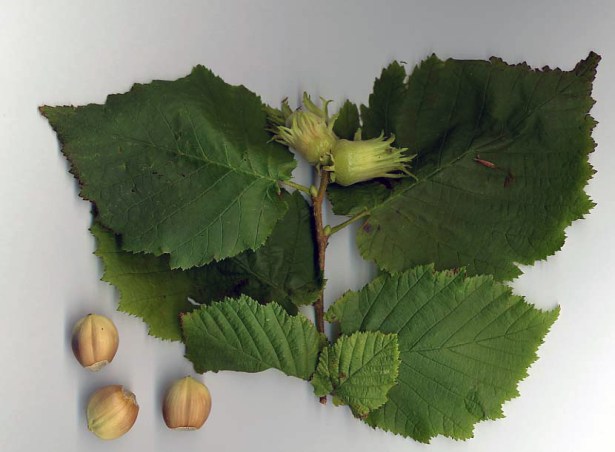
Our native hazel is Corylus avellana. The filbert with its ‘’bearded’’ cover is C. maxima. W.J. Bean lists 10 species, Hillier’s Manual, 8 species. The 2004/5 RHS Plantfinder has 53 entries of species and varieties.They are all native to Northern climes. It is suggested by Bob Flowerdew that these two and C. americana and C. colurna have all interbred to some extent and account for our productive nut clones of today. (see refs. below).
The problem with our local C. avellana for production of nuts is partly due to them being on the very good glacial soils of Tayside, making very vigorous trees, and their close planting drawing them up to the light. So, don’t be too worried about planting on a stony or less favourable soil, though probably avoid wet areas and frost hollows. And don’t crowd them in. A nice well-drained slope with some protection from the East is probably ideal. And they quite like an alkaline soil, though this isn’t essential.
Our local hazels flower very early, sometimes February, usually March. The male catkins are forming, and extending from November, the little red females later. They are wind pollinated, so shaking the branches, or even performing pollination with a little brush on a nice early spring morning is ideal. Of course, you would need reachable branches to do this. Hopefully the male and female flowers will be open at the same time. Our native Hazel must undoubtedly be very hardy, though the non-cropping years are probably due to frost damage. I wonder if we should be investigating late flowering varieties here in Scotland? (See lists below from various authors).
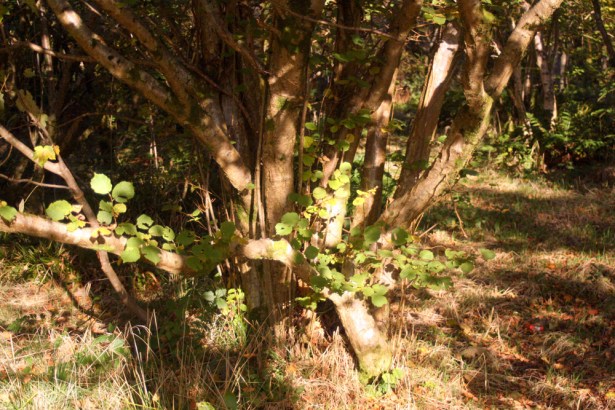
Hazels to coppice at Duchess Woods
When you receive a new tree, aim to have a short stem and 5 or 6 branches only. Tie these down or put spacers in to make these fairly horizontal – i.e. make a goblet shape. Any shoots coming up through the centre should be ripped off, and suckers removed also. This may be a continuous exercise every year judging by our local trees. When only 30cm long, allow these framework branches to divide.
So you have achieved a nice open centred tree in the first few years… maintain this framework and head back new growth to keep these trees just above head height so you can pick the nuts. The next stage is to allow lots of laterals to form on your main branches. Strong ones are cut back to two buds, weaker ones may be left. In March, after pollination, cut back the tips of the laterals to a pollinated flower. This is where your nuts will be forming. Then in August, all strong lateral growths are ‘’brutted’’, i.e. the ends are snapped to leave them hanging. This slows down the growth of the tree, lets air in, and puts energy into the nuts. The brutted shoots are cut back in the winter again.
Cross-pollination seems to be important for many varieties and clones, so don’t just buy one tree or variety. Each year try to find another to add to your wee collection. Plant them in a group to aid wind pollination, 4 m apart maximum.
So, in essence it is a bit like pruning a cordon apple tree on each branch if you are familiar with that. A vigorous tree, removed of all excessive growth, and prevented from crowding itself, and having some pollination partners, is the aim. Then there’s the birds, the squirrels and bud mites, and nut weevils to contend with…
Sanders, pge. 58 (see refs) has a good description of the pruning method described above.
Some varieties to look out for:
- Kentish Cob ( Longue D’Espagne )
- Webb’s Prize Cob
- Bollwyller
- Cosford – thin shelled, good pollinator
- Pearson’s Prolific ( Nottingham ) – smaller tree
- Filberts: Red Lambert
- Trazel (cross between C. avellana and C. colurna) Chinoka and Freeoka.
The Victorians took a good interest in Hazelnuts, and Hogg listed no less than 32 varieties.(pages 426-433 in the 1884 edition). Including the following:
- Atlas ( C. algeriensis, the Spanish Cob ).
- Aveline De Provence
- Barr’s Spanish
- Bizane
- Bond
- Burchardt’s
- Burn’s ( a grappes precoce )
- Cannon Ball
- Cluster ( a grappes )
- Cosford
- Daviana
- Duke of Edinburgh
- Eugenie
- Frizzled Hazel ( C. laciniatus )
- Frizzled Filbert
- Hartington Prolific
- Lambert Filbert ( syn Kentish Cob and Webb’s Prize ?)
- Large Black Fruited ( a gros fruits noirs )
- Lichtenstein’s
- Liegel’s
- Loddiges’ Barcelona
- Merveille De Bollwyller
- Norwich Prolific
- Pearson’s Prolific
- Primley
- Prolific Filbert
- Purple Filbert
- Striped Fruited ( a fruits Stries )
- St .Grisier
- The Shah
- White Filbert
The National Fruit Collection has Filbert Frizzled, and Kentish Cob, Butler, Ennis
The Kentish Cob Association lists the following trees:
- Kentish Cob is a reliable cropper, relatively hardy, with excellent flavour. It is recommended for domestic use. It is pollinated by Gunslebert, Cosford and Merveille de Bollwiller, and probably also by wild hazels.
- Merveille de Bollwiller (also called Hall’s Giant) is a hardy, vigorous and productive variety with large nuts. It is pollinated by Kentish Cob, Cosford, Butler and Ennis.
- Butler is a large mid- to late-season nut. It is hardy, vigorous and a heavy cropper, and a short-husked variety which de-husks freely when ripe. It is popular for modern commercial production, and is pollinated by Ennis and Merveille de Bollwiller.
- Ennis is a very attractive large round nut with a superb flavour, but a tendency to produce a significant proportion of blank nuts. It is pollinated by Butler and Merveille de Bollwiller.
- Purple Filbert (also misnamed Red Filbert) is an ornamental variety with red or purple leaves. It produces a small crop of thin-shelled nuts of excellent flavour but which are particularly susceptible to nut weevil. It is not recommended for nut production.
WJ Bean, Hardy Trees and Shrubs of the British Isle.
- Corylus spp. listed:
- americana
- avellana,
- chinensis
- colurna
- jaquemontii
- cornuta
- heterophylla
- maxima
- sieboldiana
- tibetica
Some useful references:
RHS Fruit Yearbook, 1950 by J. Turnbull, pgs 106-109.
Bob Flowerdews’s Complete Fruit Book, 1997, pges 198-199
Hogg, R., The Fruit Manual, 1884. pages 426-433.
Sanders, T.W., Fruit Growing, (no date), pages 55-61 and 215.
http://www.treesforlife.org.uk/tfl.hazel.html
http://www.snh.gov.uk/docs/B850216.pdf
http://www.forestry.gov.uk/pdf/HazelAwarenessleaflet.pdf/$file/HazelAwarenessleaflet.pdf
http://www.kentishcobnutsassociation.org.uk/a-brief-history-of-cobnuts.aspx
Finally, do hazelnuts float?
http://www.highlandperthshirenews.co.uk/general-landuse-environment/do-hazel-nuts-float
We’d love to hear from anyone who manages their hazels or cobs for their nuts in Scotland.


 plantsandapples.com