What is a wildlife garden?

We choose their plants with the aim of attracting, feeding or keeping wildlife safe in the garden. But it’s more than choosing the right plants, and more than a handy excuse for not doing any garden maintenance!

Most birds, beasts and bugs would prefer us not to garden at all, but allow nature to fill our plots with a riot of weeds and wilderness. If you’ve got space, you could do worse than part of it to go to the dogs (or the hedgehogs, blackbirds, lizards and bumblebees). But if you still want a garden – at least in part – you will need to be at least a little selective.

You’ll definitely want clumps of stinging nettles – the larval food source of many butterflies and moths, including the small tortoiseshell, red admiral and peacock. You will leave untidy piles of twigs and logs for wrens to nest in and toads to lurk under. Leaves will be left for beetles and centipedes to crawl though, and wet, boggy areas for dragonflies, damselflies and amphibians. You won’t worry too much if (when) it all looks a mess. Even slugs and snails will be a boon for attracting song thrushes.

Don’t worry if plants come up in the wrong place, or run to seed. Many birds will enjoy those apparently dead seed-heads in winter. We have developed a battery of sound ecological excuses for not being tidy gardeners!

So,

  • Seeding plants, such as teasels, milk thistles and wild oregano must be included if you want goldfinches and similar birds. Even plants with tiny seeds, like salad burnet are good and all these look dramatic in winter.
  • Shrubs with berries for fruit-loving birds and mammals. This includes the “spare” fruits on your currants, raspberries and crab apples! Be aware the blackbird will have ALL your cherries – and windfall apples will be very welcome to thrushes, fieldfares and jays.
  • Large-leaved plants, such as bistort, lungwort, elecampane and comfrey for amphibians to hide under.
  • Nectar plants with long flower tubes for butterflies. Orpine, bergamot, valerian and Welsh Onion get many visitors.
  • Evening flowering plants for moths. Try honeysuckle, evening primrose or sweet rocket.
  • Plants with flat flowers for hoverflies, drone flies, and lacewings. Yarrow is a good one, as are tansy and coriander.

Bees deserve a page of their own!

Migrating

Hold your horses!

We’re in the middle of migrating our website, and there are a few sections still to be transferred.

Our plant and fruit tree catalogue are on their way, as are our resources pages.

Come back soon!


Birdseed Bonanza

Goldfinches came to the garden this morning and dithered for ages in front of the window industriously gathering seed from the dead heads of meadowsweet. I was so glad I had not cut them back yet. Nature does not share our compulsion to order and tidiness, so seed-eaters such as finches, buntings and sparrows thrive in neglected gardens like mine. They really appreciate it when we are slow to tidy up and good seed-bearing plants tower gaunt and brown into the winter!

Apart from meadowsweet, I have found goldfinches to be particularly fond of the dead but still fragrant heads of wild oregano, and the copious, fluffy seeds on Hemp Agrimony. This is a tall, stately native plant with big, brush-like heads of purple flowers in late summer and autumn. It likes to grow in damp places but does well in most garden soils. The flowers are much visited by bees and butterflies, making it excellent value for wildlife gardening.

Milk Thistle

Most of the thistle family provide good birdseed once the flowers have faded. Here you will note a conflict of interests – the last thing a gardener needs is weed thistles running to seed in the hope the birds will enjoy them, because for every fattened bird there will be a hundred new thistles choking up your border next spring! However, there are several attractive, non-invasive thistles you can happily allow to run their course – the low growing Carline Thistle, the towering Scots or Cotton Thistle (Onopordon acanthium), or the variegated Milk Thistle for example. Spectacular Cardoons or Globe Artichokes have massive thistly heads which look great even when gone over and will bring in goldfinches and chaffinches. Of course, you might have eaten the globe artichokes yourself, but it’s worth leaving some to feed the birds as well as enjoy the sight of the lovely purple flowers! Globe Thistles are related, but bear spherical heads in blue or white that bees and hoverflies love, and provide substantial seeds when they ripen.

Sparrows, linnets and yellowhammers all enjoy seeds from grasses and cereals, and there are many attractive varieties, from the delicate Golden Millet to the chunky Pampas Grass, which will meet their needs. Seeds from the edible members of the goosefoot, or spinach family are always appreciated – such as Good King Henry, Red Orache and spinach beet that has bolted.

Finally, if you have ever bought wild bird seed you will know that sunflower seed is a big favourite. As the big flowers bend over and the petals fade, don’t bin them! Let the seed gradually ripen for the birds to find. I must admit that I kept banging my head on mine, though, as they keeled over at 45 degrees – a neat and tidy answer was to cut off the heads and hang them to dry from the shed roof, where I expect the Bankfoot Sparrow Gang will eventually decimate them!

© Margaret Lear, Bankfoot. Originally published in Comment, October 2009.

Of Coltsfoot and Liquorice

Yesterday I found the first scaly-stemmed flower of Coltsfoot pushing itself up through the disturbed ground of a plantation in Bankfoot. The plant, also called “Son-afore-the-Father” due to the fact that the flowers appear many weeks before the hoof-shaped, hairy leaves, is a spring herald. It’s particularly welcomed here because by mid-February I have always been caught by one of those coughs that cling to the tail of a winter cold and threaten to sit on your chest for months. This year is no exception.

Coltsfoot leaves and the sunny, dandelion-like flowers are equally useful for treating coughs, though personally I can’t bear to pick the brave flowers and collect and dry leaves all summer instead to see me through. They can be made into a tea, or a decoction. Of old, they have been used in herbal tobacco, too, but it beats me how smoking anything can cure a cough, so I’ll stick to tea. It doesn’t have much flavour, so I add evergreen thyme (also good for coughs!) in winter, and in summer a few leaves of mint, lemon balm or meadowsweet. Fresh coltsfoot leaves can also be used as a vegetable and even yield a yellow-green dye.

This winter, thanks to an excellent evening class in herbal medicine I have discovered another cough-soothing delight – liquorice.  I have never liked liquorice allsorts, and for all I respect the monks of Pontefract, their “cakes” and the long tradition of growing and processing liquorice in that district, NOTHING would have persuaded me to chew liquorice root if I’d known what it was. But the unprepossessing and rock-hard root is something else entirely. The flavour is sweet and delicate; I’ve been boiling chopped root for ten minutes, then adding coltsfoot leaves. On Bad Throat Days, in goes a spoonful of honey from my bees too. Liquorice has been used medicinally for over three thousand years, for constipation and stomach ulcers as well as bronchial complaints. It’s a substance called glycyrrhizin in the roots, sweeter by far than sugar, which accounts for its use in confectionery. I don’t know which bit makes foam, but it’s also used in fire extinguishers!

Coltsfoot is best gathered in the wild unless you have a large garden – it spreads most obligingly. Liquorice, a native of south-eastern Europe, is slow to germinate, the seeds are expensive, and it will take a while to produce worthwhile roots. But it has pretty foliage and pea-like flowers to enjoy while you are waiting, so is well worth growing.

Today, five inches of snow covered 2005’s first coltsfoot, and I’m still coughing, so spring had better get a move on. The hedgerow pharmacy is in demand!

© Margaret Lear, Bankfoot. Originally published in Comment, March 2005

Dancing with Faeries…

I am not a great enthusiast for lawns. Nothing against grass, you understand, and even when mown and edged it has its place – for picnics, sunbathing, throwing sticks for the dog, and so on. But the lawn is not exactly exciting, is it?

Faery Ring

Unless something Goes Wrong with it. To some people, the sudden appearance of circular, dark green patches on the lawn is Something Going Wrong. And it may be – the circular patch becomes a ring, and in some disturbing cases a double ring, with fungi on the outer edge for a brief time, and dead grass (soon followed by weeds) in between the rings. This is the worst scenario, and most people just see dark green rings and, often, no fungi at all.

These rings were noticed in meadows and pastures centuries ago, and largely attributed to the pattering feet of faeries dancing round in circles. Belief in “other” folk was commonplace and accepted, as was the presumption they could do some harm if crossed.

There is an old Scottish rhyme which sums it up:
“He wha tills the fairies’ green,
Nae luck agin shall hae,
And he wha spills the fairies’ ring,
Betide him want and wae,
For wierdless days and weary nights
Are his to his deein’ day!”

The more rational (or less imaginative) put the phenomenon down to lightning, the feeding of cattle or the mating rituals of moles. The fungi sometimes seen were thought to grow on the slimy trails of slugs attracted to the greener grass. In fact, as we now know, the fungi CAUSED the faery rings.

Think about it. Nearly all fungi grow outwards in a circle from a starting point. Penicillin mould on bread. The way an apple rots, with concentric rings of fungus. That fungal skin disease isn’t called RINGWORM for nothing! Below the soil, the perennial mycelium (“roots”) of the fungus grows silently outwards. Mushrooms (toadstools if you prefer) are produced on the outer edge of the ring when conditions are right – not necessarily every year. The mycelium consumes carbohydrates and proteins in the soil as it advances, and converts some of it to ammonia, which is then converted to nitrates by bacteria. Nitrates – yes, the basis of “greening up” lawn fertilisers. No wonder there’s a dark green ring! But with some species, such as the Fairy Ring Mushroom (Marasmius oreades), which is delicious but tricky to identify safely, the mycelium grows so densely in the soil it forms an impermeable layer of fibres, through which rain cannot penetrate. The grass behind the ring dies. Eventually, so does the mycelium. And as the grass and the fungal remains decompose, they in turn yield nitrogen – feeding the grass behind and forming an inner ring.

Year on year, the ring gets wider and wider, until we are scarcely aware of it. You may find Parasol Mushrooms (Lepiota), Field Mushrooms (Agaricus), Puffballs (Clavaria and Lycoperdon species) and many other edible species growing in rings – and quite a few non-edibles too! The most exciting one I ever found was as a teenager at the very start of my obsession with fungi, researching for my college project. It was a MASSIVE ring in dense woodlands, of the Giant Funnel-cap, Leucopaxillus giganteus, a species of edible mushrooms each a foot across, all glowing an eerie white in the gloom. This species can mither about below ground for half a century before producing mushrooms, so I was enthralled and very lucky.

I went home and promptly wrote a faery story…

© Margaret Lear, Bankfoot. Originally published in Comment, September 2011

Gently Fermenting

I have mentioned before how in autumn my house fills with apples and pears, none of which I am allowed to touch until they have been marched off to apple days, conferences or shows. By which time they get a bit past it, and people start asking where I got the cider-flavour air freshener.

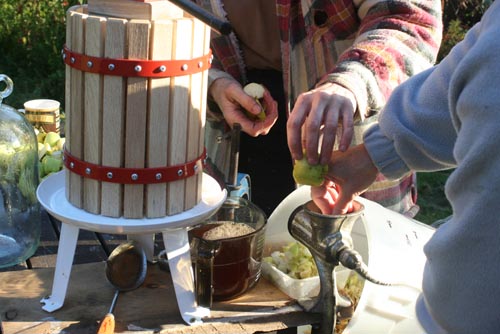
Cider-press

We are getting better at it. The construction of a lean-to back shed with shelves for trays of apples, and the brilliant but hitherto strangely overlooked option of turning off the heating in one room and closing the door, slow down the rot. So we are likely, even in this year of poor productivity, to have a fair few fruit to process in a couple of weeks.

The first option, after eating the ripe ones and storing the most sound of the slightly unripe, will be to juice them. Some apples and pears are quite dry, and juicing shouldn’t be attempted unless you have a real stack of them – let them ripen first. Others are just made for juicing, and a couple of carrier bags full will yield a gallon of pure juice. Mostly, a mixture of varieties is best – and don’t worry about including cooking apples. Once juiced, they are sweet and full of flavour.

The apples must be washed, and any seriously rotten bits cut out. If the fruit is straight off the tree, we think a cursory hose down is plenty of hygiene! We borrow a big electric crusher and throw the apples in whole – if you are using a hand crusher, it’s best to cut them in halves or quarters first. First year we juiced, we used a meat mincer. It worked, but slowly! The crushed fruit is then placed in the press wrapped in coarse sacking-like cloths. As the pressure is applied, juice starts to run freely – don’t forget the bucket to catch it in! It is ready to drink – you add nothing and take nothing away. We bottle the spare in small plastic bottles or old drinks cartons and put it in the freezer. However, you can refine it if you wish. Pure fresh apple juice is usually brown (due to tannin in the apples) and cloudy. Leaving it overnight sometimes clears it completely and you can siphon the clear juice off the sediment. If this doesn’t work, you can try adding the enzyme pectolase, which should clear the pectin that causes haziness. I’ve never known this to work well, and nor does filtering! If you haven’t much freezer room, you can pasteurise the bottles of juice by placing in a vat of cold water, raising the temperature to 70 degrees and keeping it there for 20 minutes.

Left alone, the juice will start to ferment within days. Wild yeasts work on the fruit sugars to turn them to alcohol – cider. Cider made accidentally this way can be superb – or appalling! If we want to ferment our juice we try to be a little more scientific. This means adding Camden tablets to kill off undesirable microbes that would taint it. This also kills the wild yeast, so we have to add some more. We make sure air is excluded completely, first with cotton wool, then an airlock. After a few days, fermentation is dramatic, and calms down after a few weeks. When it’s about stopped, we siphon the cider into lemonade bottles, with a teaspoon of sugar. This sets off a wee secondary fermentation, giving us a sparkling cider when we open the bottles at Christmas!

Our cider is nothing like shop-cider, and probably too dry and sour for some. It’s always unpredictable, because we are using a different mix of apples each time. We’re growing some proper cider apple trees, but for now, we are very happy to experiment and see what it turns out like – it’s all part of the fun of Appletreewidowhood!

© Margaret Lear, Bankfoot. Originally published in Comment, October 2012

Birds and Berries

Bullfinch (Pyrrhula pyrrhula)

We have a liberal attitude to kleptomaniac birds. We are quite happy to share the abundance of our raspberry crop with the needy families of warring blackbirds in the hedge, and don’t begrudge the bullfinches a little bit of plum blossom (mind you, they were pushing it last year.). I don’t object to them taking every reachable holly berry from our tree, because I am happy to trek a mile or so to a far more prolific bearer for my Christmas decorations. The walk is good for me. Honestly. With much of northern Perthshire currently in the grip of permafrost, it’s comforting to lurk behind festive windows and watch the resourceful birds make the most of the berries they can find in the garden. In Autumn, blackbirds and robins cheerfully hacked away at the crab apples, but these are long gone. Rowan berries last a bit longer, and if you have a pink or white berried Rowan (Sorbus hupehensis or cashmeriana are the species to look for) the birds may leave some till winter ends. If your tree is prolific, grab your own share for delicious rowan jelly to go with Christmas dinner or game; and a decent country wine can be had from them as well. Added to which, of course, a rowan tree in your garden will provide protection against evil spirits! (Turning off the TV has a similar effect). We have a Guelder Rose (Viburnum opulus) in the garden. It’s not a rose of course, but a small tree or shrub also known as Cramp-bark. You will not be surprised to hear that its bark was used to appease stomach cramps, among other things. The berries, which follow the creamy flowers, are a beautiful translucent red and are borne in such abundance, some are on the tree still, despite being raided by finches, starlings, robins and the Bankfoot United Sparrow Thugs (currently running in a gang with chaffinches and siskins it seems). If the birds can spare any, Cramp-bark berries may be used in tarts and sauces (but are indigestible to us unless cooked and sweetened), and may ward off scurvy should your Christmas diet have been short on Brussels sprouts! Between us, the birds and I have polished off the elderberries long since, but it’s a shrub I would highly recommend for wildlife if you have room. In fact I am not sure how anyone can manage without it – aside from its many household uses (dyeing, firewood, cosmetics, wood stains, charming warts and so on…..), 70 illnesses were recorded in 1666 by Martin Blockwitch in his “Anatomie of the Elder” against which this much maligned “weed” is effective! Of the more “gardeny” shrubs, Pyracanthas, Berberis and most cotoneasters will still have fruit on to feed hungry birds – and, of course, nectar for bees when the flowers come again. Which they will.

© Margaret Lear, Bankfoot. Originally published in Comment, January 2006.

Cider for Christmas?

I am not sure if any of the cider will be ready for Christmas. Some of it should be. We racked it off this weekend, but one or two gallons are still fermenting furiously. It is astonishing that although every gallon was made on the same day, in the same conditions, and all with assorted apples, no two jars are alike. They have all been on the same windowsill, but some started late, some finished early, the colours all vary slightly and the taste – as far as we have tested – also varies from very sweet to getting dry. NONE – so far – taste sour or vinegary I’m glad to say!

Morning sun gets the cider bubbling

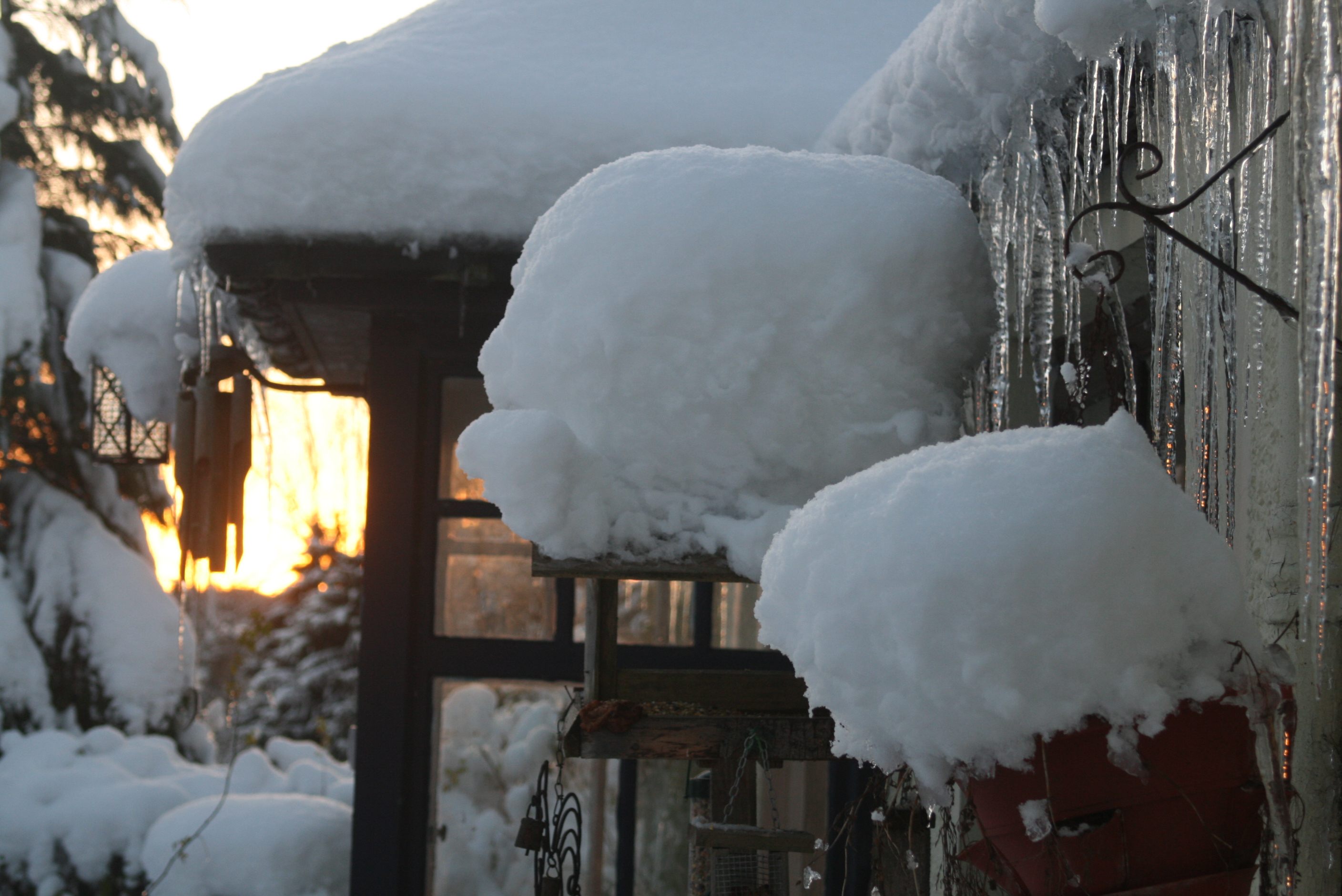
A slight thaw towards the end of last week – many wild birds are very glad of the food we are all putting out, and now finding more that had been covered by the snow. The blackbirds are especially fond of the apples that are not going to last in storage. Waxwings are about in the oak tree at the top of our road, and spotted woodpeckers have been seen (but not by me). Tremendous icicles formed hanging gardens and broke gutters; now it has turned icy cold again and the partially melted snow has refrozen to a skating rink. I never took to skating.

Hanging Gardens