
July – Week Four
Ah, now we’re talking. This weekend, Andrew and I, having spotted some growing by the A9, went cycling after Red Elderberries. These are the fruit of Sambucus racemosa, a non-native but commonly naturalised sister of the familiar Elder (Sambucus nigra). They ripen earlier than the native berries and don’t taste quite as good, but can be used for the same things. Being in the midst of a glut of soft fruit, we wanted to pick some to mix 50-50 with blackcurrants for a red wine. After picking them we thought, it having rained copiously last week (especially on Mull of course), that we should just check for fungi….. and YES!! the first Chanterelles, and a couple of Brown Birch Boletus, and a few fairly chewed Russula lutea. These all went into a delicious pie for dinner. Pointed out we still have last years dried chanterelles to use up. On the way back we picked wild cherries and wild raspberries (inexplicable as the garden ones are coming out of our ears at home but we couldn’t resist….. we ate them as a TV snack to accompany Midsomer Murders (well, you need something..)
Today I sampled the pickled ash keys I prepared in March – and they were good! I seem to have perfected the timing and recipe (well it was John Evelyn’s recipe to the letter actually).
July – Week Five
We’ve both had a week more or less off work this week – though spent much time in the garden.
We decided it was time to see what was happening in a local Forestry Commission wood which gets a good range of autumn fungi normally…. I wanted Tawny Grisettes especially, and there were quite a few. This is an un-nerving fungus for the beginner, being in the same family as Death Cap and Destroying Angel (Amanita). But once you know it, you can’t mistake it for anything else, even from a distance. It stands on a tall stem, no ring around it unlike the death cap, and the reddish-brown cap, conical at first but soon flat, is edged with little striations. Slugs love them (regrettably) and so do I. We also found a single Bay Boletus (Boletus badius), and a relative we hadn’t tried before – Suillus variegatus. This was nice, though not over-tasty. There were quite a few edible Russula atropurpurea, but the slugs had largely had them already! But there were MOUNTAINS of chanterelles….. kept us going for days…..
Dimly aware the English school holidays were starting, we also gathered several pounds of blaeberries (bilberries) by the River Braan. The connection here is that the English hols is when we are most likely to meet up with Tim and Gill and their daughters. Tim is a compulsive and exhausting forager even by our standards, and we have fond, gooey memories of Tim’s blaeberry muffins! Anyway, as usual we spent ages filling a bag with small, sparse and hard to find berries on ankle-high plants, only to get round the corner and find big juicy ones a dozen to a stem on nice tall bushes, which took no time at all to pick. The moral is never start picking till you’ve found worthwhile quantities! The blaeberry is good wayside snacking; they have kept us going all week on walks and cycle rides, here and up at Braemar where we went camping.
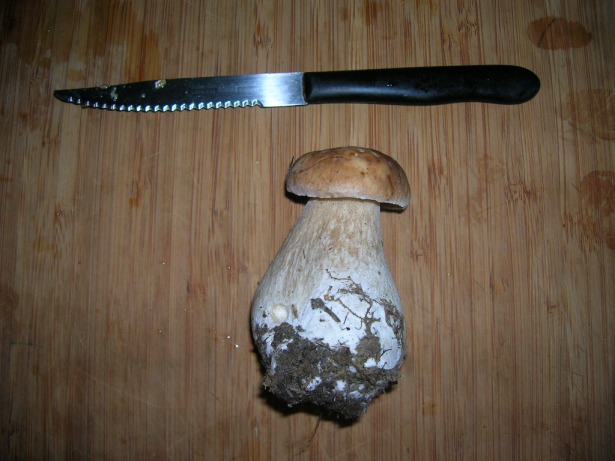
Cep (Boletus edulis)
On Monday, Andrew spotted a perfect, un-maggoty, classic Cep (Boletus edulis). They’re called King Boletes on the continent, and they taste magnificent. This one did both of us for breakfast. To finish the week, I’ve just come back from a bike ride. I had no intention of foraging so didn’t take a bag. Instead I ate all the big juicy wild cherries there and then (pig). But when I saw the chanterelles in the wood…. well, did you know you can stuff the sleeves of a cardigan full of fungi, tie it round your waist and get them home in perfect condition? Good timing, I was seriously thinking of buying some mushrooms.
 plantsandapples.com